Planning an event takes far more than booking a venue and sending invitations. A successful event needs clear objectives, a realistic budget, a detailed timeline, reliable vendors, early production planning, guest management and a contingency plan. This guide takes you from planning through production, event day and post-event evaluation.
These event management tips apply to corporate events, conferences, awards ceremonies, brand activations, product launches, exhibitions, fashion shows, concerts, gala dinners and weddings. The formats differ, but the discipline underneath them is the same. If you want a broader view first, see the different types of event management, or read the event management planning guide, which covers the planning stages step by step. This article focuses on the practical moves that separate smooth events from stressful ones.
Quick Tips Event Management Checklist
| Before the event | Event day | After the event |
|---|---|---|
| Objectives | Setup | Feedback |
| Budget | Testing | Reporting |
| Venue | Guest arrival | Budget review |
| Vendors | Show execution | Vendor review |
| Production | Monitoring | Lessons learned |
What Makes an Event Successful?
Before the tips, define the goal. A successful event is one that achieves its intended objective while being well planned and well executed. It is not necessarily the biggest or most expensive event.
Success usually combines several outcomes:
- The event objective is achieved.
- The budget holds.
- The timeline is met.
- Attendees have a positive experience.
- Production runs smoothly.
- Vendors are well coordinated.
- No major operational issue disrupts the day.
- Business or engagement goals are measurable.
Notice that most of these are decided long before the doors open. Event day is largely shaped by the decisions, preparation and coordination that happen beforehand.
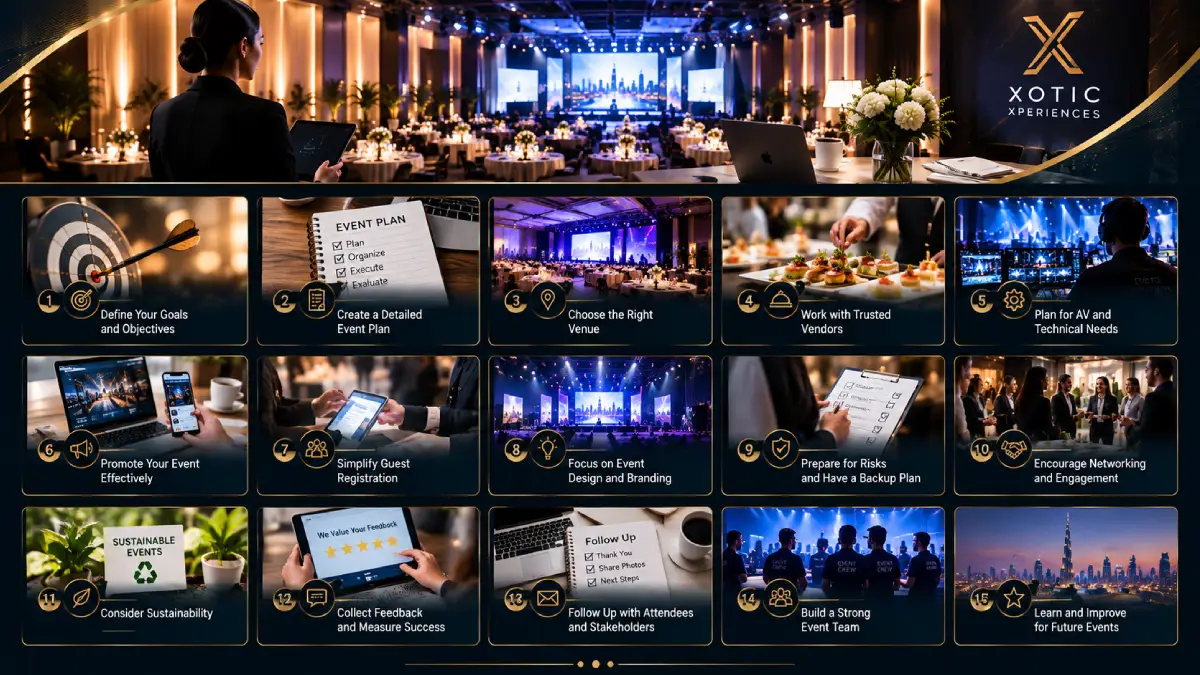
15 Event Management Tips for a Successful Event
1. Define Your Event Objectives First
Settle the purpose before choosing a venue, theme or entertainment. Ask:
- Why are we holding this event?
- What should attendees do or learn?
- Who is the target audience?
- What does success look like?
- What should happen after the event?
A product launch may aim for product awareness. A corporate conference may aim for knowledge sharing and networking. Each goal leads to different choices.
2. Understand Your Target Audience
Your audience shapes the venue, format, content, entertainment, catering, communication, seating and technology. An event for senior executives needs a different approach from a consumer brand activation. Executives value punctuality, privacy and efficient programming. Consumers respond to interaction, photo moments and a relaxed pace.
3. Set a Realistic Event Budget
List every cost category before you commit to suppliers:
| Category | What it covers |
| Venue | Hire, setup and breakdown time. |
| Production | Stage, lighting, sound, LED screens. |
| Catering | Food, drinks, service staff. |
| Staffing | Registration, security, logistics. |
| Entertainment and décor | Performers, styling, theming. |
| Marketing | Invitations, promotion. |
| Other | Transportation, permits, photography and video. |
Do not allocate the whole budget to planned expenses. Keep a contingency amount for unexpected costs and last-minute changes. Many planners hold back a percentage for this, and the right size depends on the event’s complexity and risk.
4. Build a Detailed Event Timeline
The event date is not the same as the planning timeline. The timeline shows what must be done, and by when, to reach that date.
| When | Focus |
| 12+ weeks before | Objectives, budget, venue, concept. |
| 8–12 weeks | Vendors, production, invitations, content. |
| 4–8 weeks | Guest confirmations, design, AV, logistics. |
| 1–2 weeks | Final checks, rehearsals, run-of-show. |
| Event day | Setup, testing, execution, monitoring. |
| After the event | Breakdown, reporting, feedback. |
These ranges are a guide. Larger events, custom builds and permit-heavy formats need more lead time.
5. Choose the Right Venue
Appearance matters, but function matters more. Check:
- Capacity and location.
- Accessibility and parking.
- Power supply and loading access.
- AV capabilities and stage possibilities.
- Catering options.
- Branding restrictions and technical restrictions.
- Guest flow.
Always visit in person. A photo will not show you that the loading door is too narrow for your staging or that the power panel sits on the far side of the building. For Dubai events, ask early about venue approvals and event permits, since these depend on the event type and venue. An experienced Event Management Company in Dubai can guide you through the local requirements.
6. Create a Clear Event Plan
The event plan is the central reference for the whole team. It should record the objectives, budget, timeline, guest list, venue, suppliers, production, staffing, logistics, communication and contingencies. When a question comes up in week nine, the answer should already be in the plan.
7. Build a Strong Vendor Management System
Vendors deliver much of what guests see, so manage them as partners. For each one, record:
- Quotes and contracts.
- Deliverables and deadlines.
- Contact details.
- Setup requirements.
- Payment schedules.
- A backup supplier for critical services.
Coordination matters most when many suppliers work in one space. Confirm arrival order and timings in writing.
8. Don’t Leave Event Production Until the Last Minute
Lighting depends on rigging, and rigging depends on venue approval. AV depends on power. Stage, lighting, sound, LED screens, AV, technical equipment, fabrication and rigging depend on one another. Lighting depends on rigging, and rigging depends on venue approval. AV depends on power.
Late changes cost more and carry safety risks. Involve production early so it can influence venue choice, layout and schedule. Plan for show calling and rehearsals from the start.
9. Create a Detailed Run of Show
A run-of-show is a line-by-line agenda for event day. It lists what happens, when, and who is responsible. Here is a simple example:
| Time | Activity | Responsible team |
| 6:00 PM | Guest arrival. | Guest team. |
| 6:30 PM | Opening. | Stage team. |
| 6:35 PM | Welcome speech. | Speaker team. |
| 6:45 PM | Presentation. | AV team. |
| 7:00 PM | Main segment. | Production. |
| 7:30 PM | Entertainment. | Show team. |
For complex events, add columns for duration, technical cues and notes. Share it with every team so no one works from an old version.
10. Plan the Guest Experience From Arrival to Departure
Map the full journey: arrival, registration, welcome, main experience, networking and exit. At each stage, think about signage, queues, seating, accessibility, information, catering, restrooms, parking and VIP handling. Add a feedback step at the end.
Small operational details can significantly affect the guest experience. One registration lane for a large crowd creates a bottleneck in the first ten minutes.
11. Prepare a Contingency Plan
A contingency plan should address the risks most likely to affect the event. Prepare alternatives for the problems most likely to occur.
| Risk | Example response |
| Weather | Indoor backup or covered area. |
| Technical failure | Backup equipment and offline content. |
| Speaker cancellation | Replacement speaker or extended break. |
| Vendor delay | Backup supplier on call. |
| Power issues | Confirmed capacity and standby power. |
| Transportation problems | Alternative vehicles and a revised schedule. |
| Guest-count changes | Flexible seating and catering. |
Assign an owner to each risk. For a deeper look, read about crisis management in events.
12. Communicate Clearly With Everyone
Communication runs between the client, event manager, production team, venue, vendors, speakers, performers, staff and guests. Create a single source of truth for final schedules, contact lists, deliverables, approvals and changes. When everyone works from one version, nothing gets lost between messages.
13. Rehearse Before the Event
Rehearsals expose problems while they are still cheap to fix. They reveal timing errors, audio issues, lighting problems, presentation mistakes, speaker positioning, stage movement and cueing problems. Conferences and awards, fashion shows and launches benefit most. Even a short run of the opening and closing moments helps.
14. Have a Dedicated Event-Day Team
Do not rely on one person to manage everything. Assign owners for registration, guest management, production, stage, speakers, vendors, catering, VIPs, security, logistics and client communication. Give each owner a clear point of contact for escalation. This prevents one person from becoming the bottleneck.
15. Measure the Results After the Event
The event is not finished when the guests leave. Review:
- Attendance and registrations.
- Engagement and leads.
- Feedback and social activity.
- Budget performance.
- Vendor performance.
- Technical issues.
- Schedule performance.
Then ask what worked, what didn’t and what should change next time. Send surveys soon after the event while the experience is fresh.
Event Management Tips and Tricks for Beginners
These ten rules provide a practical foundation for first-time event planners.
| Beginner rule | What to do |
| 1. Start with the objective | Write it down before any other decision. |
| 2. Budget first | Create the budget before committing to suppliers. |
| 3. Document everything | Keep contracts, contacts and approvals in one place. |
| 4. Respect setup time | Allow more time than you think you need. |
| 5. Have a backup plan | Prepare alternatives for the top risks. |
| 6. Confirm in writing | Put key details in emails or contracts. |
| 7. Walk the venue | Visit before event day. |
| 8. Build in buffer time | Leave gaps between segments. |
| 9. Assign responsibilities | Name an owner for every task. |
| 10. Delegate | You cannot manage every task yourself. |
If you apply only these ten, your event planning tips will already be stronger than most first attempts.
Event Management Ideas That Can Improve the Attendee Experience
Good ideas add to a well-run event. They do not replace one. Here are options to consider:
- Interactive registration. QR codes, digital check-in or branded registration speed up entry.
- Interactive event zones. These suit brand activations and exhibitions, where visitors want to try and touch.
- Live polling. This works well at conferences and corporate events to keep audiences involved.
- Photo and content moments. Create spaces designed for guests to take and share content.
- Networking areas. Dedicated zones work better than leaving networking unstructured.
- Interactive entertainment. Choose it to fit the event format and audience.
- Personalized guest experiences. VIP areas, personal welcomes and tailored content make guests feel valued.
For interactive technology, pop-ups and product experiences, explore brand activation services in Dubai.
How to Manage an Event Successfully From Start to Finish
If you wonder how to manage an event successfully, follow this seven-step framework:
| Step | Focus | Key actions |
| 1. Define | Objectives and audience. | Decide purpose and success measures. |
| 2. Plan | Budget, timeline, venue. | Set the framework. |
| 3. Organize | Vendors, logistics, guests. | Confirm suppliers and guest flow. |
| 4. Produce | Stage, AV, lighting, technical needs. | Design and prepare the experience. |
| 5. Rehearse | Speakers, performers, cues. | Test and refine. |
| 6. Execute | Event-day management. | Run the plan with a clear team. |
| 7. Evaluate | Feedback, KPIs, post-event report. | Learn and improve. |
Each step feeds the next. Skipping one usually shows up as a problem two steps later.
Common Event Management Mistakes to Avoid
Choosing a Venue Before Understanding Requirements
Booking first can lock you into a space that cannot support your production.
Poor Vendor Communication
Unconfirmed details cause late arrivals, wrong equipment and finger-pointing.
Overloading the Schedule
A packed agenda has no room for delays, so one slip affects every later segment.
Not Assigning Clear Responsibilities
If everyone is responsible, no one is.
Failing to Measure Results
Without data, you repeat the same mistakes at the next event.
Event Management Tips for Different Types of Events
Priorities shift with the format. Use this table to focus your effort.
| Event type | Key planning focus |
| Conferences and awards | Speakers, agenda, AV, attendee flow, stage, show calling, rehearsals. |
| Brand activations | Engagement, branding, audience interaction. |
| Product launches | Product reveal, staging, media, VIPs. |
| Exhibitions | Stand design, visitor flow, branding. |
| Fashion shows | Runway, models, backstage, lighting. |
| Concerts | Sound, lighting, artists, crowd management. |
| Gala dinners | Hospitality, décor, entertainment, seating. |
The tips above stay the same across all of them. What changes is the weight you give to each one.
Conclusion
Successful event planning comes down to preparation, communication, organization and execution. Define clear objectives, understand your audience, control the budget, coordinate vendors, plan production early and prepare for unexpected issues. Do that, and you can create an event that runs smoothly and delivers the intended experience.
Frequently Asked Questions
What are the best event management tips?
Start with clear objectives and a known audience. Then set a realistic budget with contingency, build a timeline, choose a suitable venue, manage vendors carefully, plan production early, prepare a contingency plan, rehearse and assign a clear event-day team.
What are some event planning tips for beginners?
Define the objective first and build the budget before committing to suppliers. Create a timeline, visit the venue, confirm details in writing and prepare backup plans for the main risks.
How do you manage an event successfully?
Follow seven steps: define, plan, organize, produce, rehearse, execute and evaluate. Each stage prepares the next.
What makes an event successful?
Clear objectives, a well-understood audience, thorough planning, smooth execution and measurement afterward. Size and cost are not the measure.
What are some event management tips and tricks?
Test equipment on every laptop a presenter might use. Add buffer time to the schedule. Keep a single source of truth for schedules and contacts. Have a backup for critical suppliers.
What should you do first when planning an event?
Define the event objective and target audience before selecting the venue or suppliers.
How early should you start planning an event?
Start as early as the event’s complexity requires. Simple meetings may need only a short planning period, while conferences, launches, concerts and events involving custom fabrication, permits or complex production may require several months.