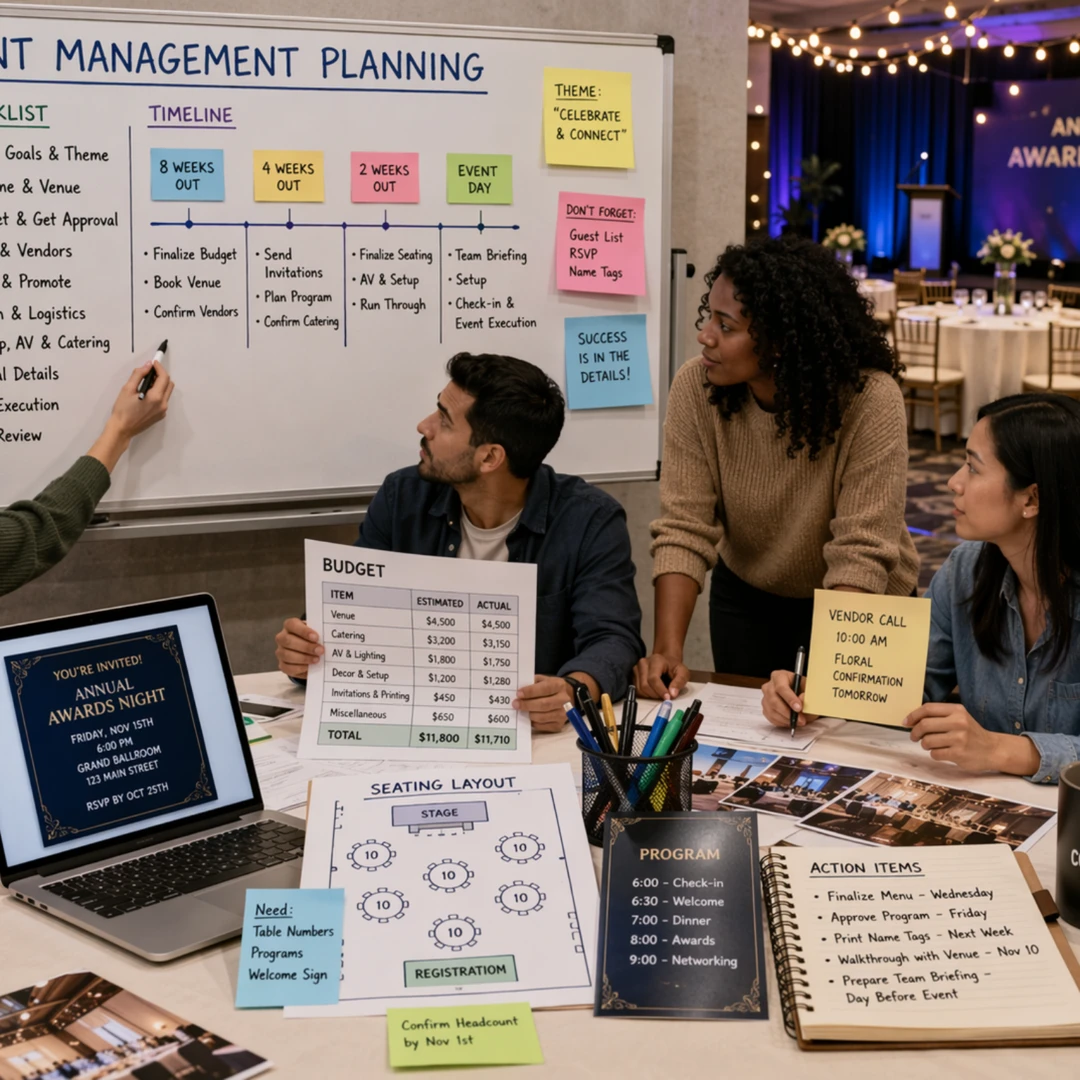
Most event planning advice is theoretical. It tells you to “set a budget” and “choose a venue” without explaining what actually happens when those decisions collide with real-world constraints — a vendor who cancels 48 hours out, a client who changes the guest count a week before, or a venue that’s double-booked on your date.
This guide to event management planning is different. It’s built around how events actually get planned and executed in the UAE market — where standards are high, timelines can be tight, and the consequences of poor planning are very visible.
Whether you’re managing your first major event or looking to sharpen your approach, this event planning guide will walk you through every stage with practical clarity.
Table of Content
- What Is Event Management and Planning?
- The 7 Stages of Event Planning
- The 5 Phases of Event Planning: A Simplified Framework
- Practical Successful Event Planning Tips for the UAE Market
- When to Work with a Professional Event Management Partner
- Conclusion: Plan With Intention, Execute With Precision
- Frequently Asked Questions
What Is Event Management and Planning?
Event management planning is the structured process of defining, organizing, and delivering an event from initial concept to final closeout. It encompasses everything from strategic objective-setting and budgeting to on-site coordination and post-event analysis.
Planning an event is not just logistics. It’s a management discipline that requires decision-making under uncertainty, stakeholder alignment, vendor oversight, and real-time problem-solving. When it’s done well, the event feels effortless. When it’s done poorly, every seam shows.
For businesses in Dubai and across the UAE, event management planning is increasingly treated as a strategic function — not just an administrative one. That shift in thinking makes a significant difference in outcomes.
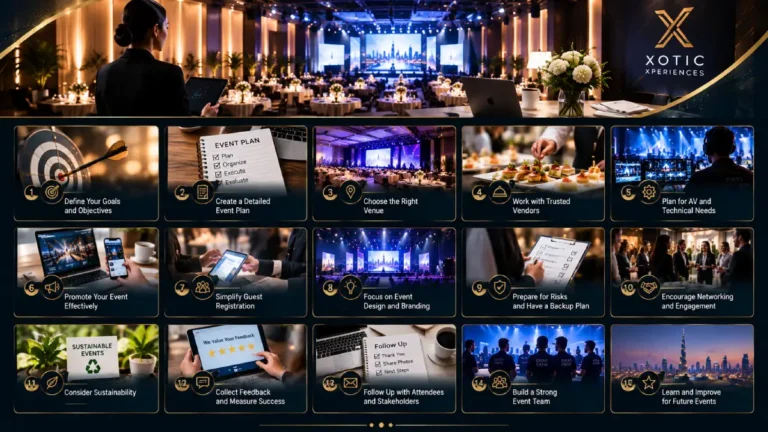
The 7 Stages of Event Planning
A structured guide to event management breaks the process into seven distinct stages. Each one builds on the previous, and skipping any of them tends to create problems downstream.
Stage 1: Define Objectives and Scope
Before any vendor is contacted or venue shortlisted, you need complete clarity on what this event is supposed to achieve. Not “a great experience” — a specific, measurable outcome.
Questions to answer at this stage:
- What business goal does this event serve? (Lead generation, relationship-building, brand visibility, internal alignment?)
- Who is the audience, and what do you need them to think, feel, or do after attending?
- What does success look like — in numbers, in feedback, in outcomes?
Ambiguity at this stage is the most common cause of scope creep, budget overruns, and stakeholder misalignment later in the process.
Stage 2: Build Your Budget
A realistic event management planning budget accounts for three things most people forget: contingency (typically 10–15% of total budget), post-event costs (teardown, reporting, follow-up), and the cost of changes — because changes always happen.
Break your budget into clear categories: venue, catering, AV and production, decor, staffing, marketing and communications, and technology. Don’t aggregate everything into one line. Granularity is what allows you to make smart trade-off decisions when you need to.
Stage 3: Venue Selection and Logistics Planning
Venue choice should follow objective clarity — not precede it. The right venue for a high-intimacy client dinner is completely different from the right venue for a 400-person product launch.
In the Dubai market, venue availability can be tight during peak season (October–March). Build in lead time and always have a backup option identified. When working with a local event company in Dubai, you benefit from established venue relationships that can unlock better rates and priority access.
- Check exclusivity arrangements — some venues require you to use their in-house catering and AV.
- Confirm load-in and load-out windows — especially important for large production setups.
- Understand the venue’s insurance and liability requirements upfront.
Stage 4: Vendor Management
Your event is only as strong as your weakest vendor. Successful event planning tips consistently point to vendor relationship quality as a top predictor of execution success.
For every key vendor — catering, AV, photography, transport — have a clear brief, a signed contract, and a defined escalation path if something goes wrong. Don’t rely on verbal agreements for anything significant.
The best event management companies in Dubai maintain trusted vendor networks built on years of working relationships. That network is part of what you’re paying for when you engage a professional agency.
Stage 5: Communications and Attendee Management
How you communicate before, during, and after the event shapes attendee experience more than most planners realize. This includes:
- Pre-event: Invitations, registration flow, reminders, agenda sharing, and logistical information.
- On-site: Signage, directional guidance, check-in experience, and real-time updates.
- Post-event: Thank you communications, surveys, content sharing, and follow-up calls where relevant.
Attending to the qualities of the best event services will show you that communications infrastructure is consistently among the most underinvested areas in mid-market event planning.
Stage 6: On-Site Execution
This is where all the planning either pays off or falls apart. On the day, the event manager’s job is to run the room — not fill gaps in planning.
Key principles for on-site execution:
- Brief your entire team the night before. Everyone should know their role, their escalation path, and what “success” looks like for their specific area.
- Run a venue walkthrough 2–3 hours before doors open. Find problems while you still have time to fix them.
- Designate one point of contact for each major vendor on the day. Don’t let multiple team members manage the same supplier.
- Keep the run-of-show visible and updated in real time. A static document that doesn’t reflect live changes is not useful.
Stage 7: Post-Event Review
The event management planning process doesn’t end when the last guest leaves. Post-event review is what separates organizations that get better over time from those that repeat the same mistakes.
A strong post-event review covers: budget actuals vs. estimates, attendance and engagement metrics, vendor performance ratings, key incident log, and stakeholder feedback. This data directly informs how you manage an event successfully the next time.
The 5 Phases of Event Planning: A Simplified Framework
If the 7-stage model is your detailed operating framework, the 5-phase model is your high-level timeline:
- Pre-planning phase: Objectives, budget, and team alignment
- Planning phase: Venue, vendors, agenda, and communications setup
- Production phase: Design, content, and technical preparation
- Execution phase: On-site delivery and real-time management
- Post-event phase: Analysis, reporting, and stakeholder follow-up
Both models are valid. The 7-stage version is better for large, complex events. The 5-phase version works well for shorter timelines or recurring event formats.
Practical Successful Event Planning Tips for the UAE Market
Beyond the framework, here are the ground-level insights that experienced event professionals in Dubai will tell you:
- Start vendor conversations earlier than you think necessary. In peak season, good AV companies, photographers, and caterers book out fast.
- Localize your F&B thoughtfully. Dubai is a diverse city — understanding dietary requirements and cultural considerations around food is non-negotiable for many events.
- Don’t underestimate the complexity of hybrid events. Running a live and digital experience simultaneously requires double the planning and significantly more tech investment.
- Build rapport with your venue’s operations team — not just the sales manager who sold you the space. The ops team is who executes on the day.
- Stay updated on event management trends — the market is evolving quickly, and client expectations shift accordingly.
When to Work with a Professional Event Management Partner
Not every event requires a full agency. But there are clear signals that suggest professional support is worth the investment:
- The event is visible externally — to clients, media, or the public — and reputation is at stake.
- The logistics are complex, involving multiple venues, large guest counts, or international attendees.
- Your internal team lacks dedicated event management experience or capacity.
- The timeline is tight and the margin for error is low.
Understanding the role of event planners in UAE businesses — and how they function as strategic partners rather than just coordinators — is worth exploring before you make a decision either way.
Conclusion: Plan With Intention, Execute With Precision
Successful event management planning isn’t about following a checklist. It’s about combining strategic clarity with operational discipline and the flexibility to adapt when — not if — things don’t go according to plan.
In a market like Dubai, the difference between a good event and a great one often comes down to who you work with and how thoroughly the groundwork is laid before a single guest arrives.
If you’re looking for a partner that brings both strategic thinking and genuine execution capability to the table, Xotic Xperiences has the experience and market knowledge to deliver — from the first brief to the final report.
Frequently Asked Questions
What are the 7 stages of event planning?
The 7 stages of event planning are: (1) defining objectives and scope, (2) building a budget, (3) venue selection and logistics planning, (4) vendor management, (5) communications and attendee management, (6) on-site execution, and (7) post-event review. Each stage requires specific decisions and outputs, and skipping any stage typically creates compounding problems downstream.
What are the 5 phases of event planning?
The 5 phases are: pre-planning (objectives and budget), planning (vendors, venues, and communications), production (design and technical preparation), execution (on-site delivery), and post-event (analysis and follow-up). These phases map directly to the full event lifecycle and provide a clear structure for managing timelines and responsibilities.
What is event management and planning?
Event management and planning is the end-to-end process of conceptualizing, organizing, and delivering an event to achieve a specific objective. It encompasses strategic planning, budget management, vendor coordination, attendee communications, on-site execution, and post-event measurement. In a professional context, it’s a management discipline that requires both strategic thinking and operational precision.
How far in advance should I start planning an event?
For large-scale corporate or public events in Dubai, ideally 4–6 months in advance. For mid-size events (100–300 attendees), 8–12 weeks is a reasonable minimum. For smaller, recurring events, 4–6 weeks may suffice — but even then, key vendors and venues should be secured as early as possible, particularly during Dubai’s peak event season between October and March.
What is the most important factor in successful event planning?
Objective clarity is the single most important factor. Every other decision — venue, budget allocation, format, audience experience — should flow from a clearly defined outcome. Events that start without measurable goals consistently underperform because there’s no shared benchmark for what success looks like, and no basis for making smart trade-off decisions along the way.