
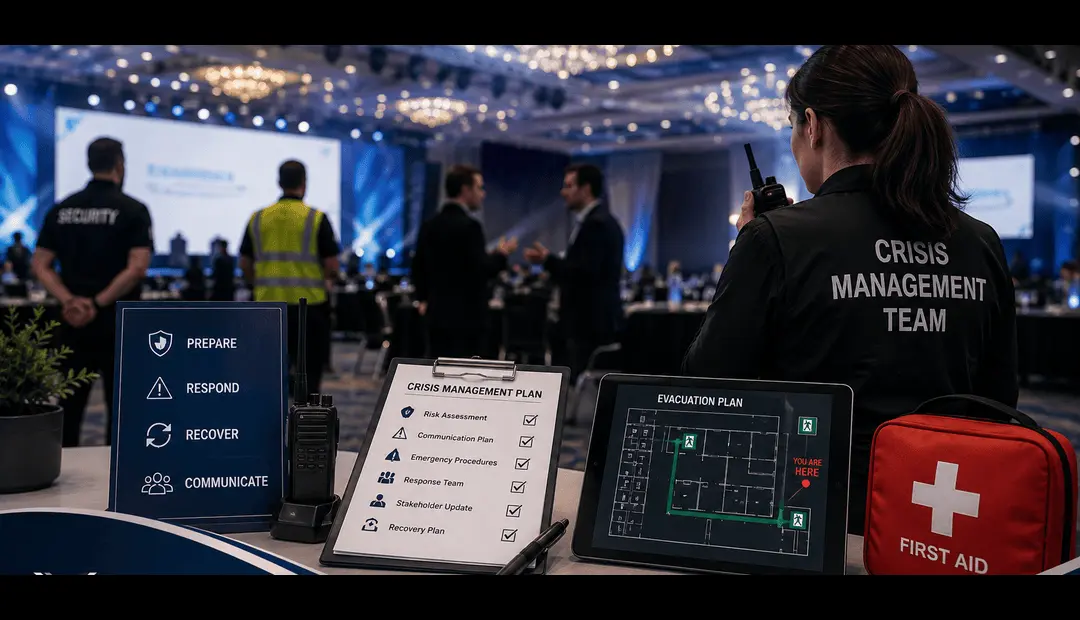
Crisis management is the process of preparing for, responding to, and recovering from unexpected events that threaten an organization’s operations, safety, or reputation. Effective planning helps businesses and event organizers minimize damage, maintain trust, and ensure continuity during crises.
A vendor cancels four hours before doors open. A keynote speaker collapses on stage. A data breach surfaces the same week as a product launch. None of these situations are hypothetical, they happen to real organizations every year, and the ones that recover quickly almost always share one trait: they had a plan before the crisis, not after it.
Crisis management is often treated as a reactive scramble, something you figure out once the damage is already visible. In practice, the organizations that handle disruption well have already answered the harder question: what is crisis management, long before anything goes wrong, and built a repeatable process around the answer.
This guide covers what crisis management actually involves, why it matters across industries, the step-by-step process behind it, and how it applies specifically to live events, where the margin for error is often measured in minutes rather than days.
Table of Content
- What Is Crisis Management?
- Different Types of Crises
- Importance of Crisis Management
- Why Crisis Management Is Essential for Businesses
- Crisis Management Process (Step-by-Step)
- Key Components of an Effective Crisis Management Plan
- Corporate Crisis Management Best Practices
- Crisis Management in Events
- Major Crisis Management Mistakes
- Real-World Examples of Crisis Management
- Technology and AI in Crisis Management
- To Wrap Up
- Frequently Asked Questions
What Is Crisis Management?
At its core, crisis management is the discipline of preparing for, responding to, and recovering from events that threaten to disrupt an organization’s operations, reputation, or safety. It combines risk assessment, planning, and rapid decision-making, so a business can act decisively instead of reacting in confusion once something has already gone wrong.
Define Crisis Management
To define crisis management precisely: it is the coordinated set of processes, roles, and communication protocols an organization activates when an unexpected event threatens significant harm to people, operations, or reputation.
- Definition: a structured response framework for identifying, containing, and resolving disruptive events
- Purpose: to protect people first, then limit operational and reputational damage
- Objectives: faster decision-making, consistent communication, and a controlled path back to normal operations
What is Crisis Management in Business?
What is crisis management in business comes down to preparation built into daily operations rather than a document that sits untouched until disaster strikes. Companies that take crisis management in business seriously run risk assessments on a schedule, assign named owners to specific failure scenarios, and rehearse their response the way they’d rehearse a product launch. This turns a potential emergency into a manageable, procedural event rather than an open-ended scramble.
What is Crisis Management and Why Is It Important?
What is crisis management and why is it important, in direct terms: it is the practice of planning for disruption before it happens, and it matters because organizations that prepare in advance recover faster, retain more customer trust, and face fewer long-term financial or legal consequences than those that improvise under pressure.
Different Types of Crises
Not every disruption looks the same, and the right response depends heavily on which category a crisis falls into. Below are the categories most organizations should plan around.
1. Operational Crisis
An operational crisis disrupts the core functions that keep a business running — a supply chain breakdown, a system outage, or a facility shutdown. These crises rarely make headlines on their own but can cascade into financial and reputational damage if left unaddressed.
2. Financial Crisis
A financial crisis threatens an organization’s solvency or cash flow — sudden revenue loss, a failed funding round, or an accounting irregularity. Financial crises often require the fastest internal coordination, since delayed disclosure can compound legal exposure.
3. Cybersecurity Crisis
Data breaches, ransomware attacks, and system intrusions fall under this category. A cybersecurity crisis typically demands both a technical response and a parallel communication plan for affected customers, partners, and regulators.
4. Natural Disasters
Floods, storms, earthquakes, and wildfires can shut down facilities, disrupt travel, or endanger staff and attendees with little warning. Because these crises are largely outside an organization’s control, planning focuses on evacuation, continuity, and rapid communication rather than prevention.
5. Public Relations Crisis
A public relations crisis stems from reputational damage, a viral complaint, a leadership scandal, or a poorly received public statement. These crises move fastest on social media and require a coordinated, pre-approved communication response.
6. Product Recall Crisis
When a product proves unsafe or defective after release, the resulting recall crisis combines operational, legal, and reputational elements simultaneously, making it one of the more complex categories to manage well.
7. Workplace Safety Crisis
Injuries, workplace violence, or serious safety violations fall here. These crises carry legal and regulatory weight in addition to the immediate human impact, and they demand an immediate, well-documented response.
8. Crisis Management in Events
Crisis management in events deserves its own category because live events compress every other crisis type, operational, safety, PR, weather, into a single high-pressure window with an audience physically present. A later section of this guide covers this in full depth.
Importance of Crisis Management
The importance of crisis management becomes obvious the moment something goes wrong without a plan in place — but by then, the cost of not preparing has already been paid. Here’s what a solid crisis management function actually protects:
- Business continuity — keeping core operations running, or restoring them quickly, when disruption hits
- Customer trust — a transparent, competent response preserves loyalty even after a visible failure
- Employee safety — clear protocols protect staff physically and reduce panic-driven decisions
- Reputation protection — a fast, consistent response limits how far negative narratives spread
- Financial stability — controlled crises cost less than chaotic ones, in both direct losses and legal exposure
- Legal compliance — documented response processes satisfy regulatory and insurance requirements
- Stakeholder confidence — investors, partners, and boards judge leadership largely on how a crisis is handled
Why Crisis Management Is Essential for Businesses
Every sector faces a different mix of risks, but the underlying need for crisis management business planning is universal. Below is how it plays out across common organization types.
- Small businesses: limited resources make a single disruption, a data breach, a lost supplier, disproportionately damaging without a plan
- Large corporations: scale means more moving parts, more stakeholders, and more regulatory scrutiny during any incident
- Government organizations: public accountability raises the stakes for transparency and speed of response
- Nonprofits: donor trust is fragile, and a mishandled crisis can affect funding for years
- Event agencies: compressed timelines and live audiences leave almost no room for delayed decision-making
- Hospitality: guest safety incidents can escalate into both safety and reputational crises simultaneously
- Healthcare: patient safety and regulatory compliance intersect, raising the cost of any misstep
- Education: institutions must protect students and staff while managing parent and public communication
- Retail: product issues and in-store incidents can spread rapidly through customer-facing social channels
Across all of these sectors, corporate crisis management functions as the connective layer, the leadership-level structure that decides who acts, who communicates, and how fast, regardless of which department the crisis originates in. Whatever the sector, effective crisis management business planning ultimately comes down to the same question: who is authorized to act the moment something goes wrong.
For organizations running live programs alongside these risks, working with an established event management company that already builds contingency planning into its process can meaningfully reduce exposure.
Crisis Management Process (Step-by-Step)
A working crisis management process follows a consistent sequence, whether the organization is a hospital, a retailer, or an event agency.
- Risk Assessment — identify the disruptions most likely to affect the organization and rank them by likelihood and impact
- Crisis Prevention — put controls in place to reduce the probability of the highest-priority risks materializing
- Crisis Planning — document specific response steps, roles, and decision authority for each identified risk
- Crisis Response Team — assign named individuals to lead the response, with backups identified in advance
- Internal Communication — establish how staff and leadership will be informed and updated during the incident
- External Communication — prepare messaging for customers, media, and the public, approved in advance where possible
- Crisis Resolution — execute the response plan and make real-time adjustments as the situation develops
- Recovery — restore normal operations and address any residual operational or financial impact
- Post-Crisis Evaluation — review what worked, what didn’t, and update the plan accordingly
A crisis plan that hasn’t been rehearsed is a document, not a capability, the ninth step, post-crisis evaluation, is what turns one crisis into preparation for the next.
Key Components of an Effective Crisis Management Plan
Beyond the process itself, a usable plan needs specific, documented components that a team can act on under pressure, without needing to improvise structure in the moment.
- Risk analysis covering the organization’s most probable and most damaging scenarios
- Emergency contacts for internal leadership, external authorities, and key vendors
- A documented communication strategy for internal staff, customers, media, and regulators
- A clear decision hierarchy defining who has authority to act without waiting for sign-off
- A media response framework, including pre-approved holding statements
- Defined employee responsibilities so no one is guessing their role during the incident
- Vendor coordination protocols for suppliers, contractors, and venue partners
- Recovery procedures for restoring operations once the immediate threat has passed
- Thorough documentation of the incident and response, for legal, insurance, and review purposes
Corporate Crisis Management Best Practices
Strong corporate crisis management rests on a few consistent habits, regardless of industry or company size.
- Executive leadership that is visible and decisive during the incident, not delegating entirely downward
- Active reputation management, monitoring how the crisis is being perceived in real time
- Direct, timely investor communication for publicly accountable organizations
- Honest, consistent customer communication that avoids overpromising on timelines
- Continuous social media monitoring to catch emerging narratives before they escalate
- Close coordination with legal counsel to maintain legal compliance throughout the response
- Sustained employee engagement, since internal morale affects how the crisis is handled externally
Crisis Management in Events
Crisis management in events carries a distinct set of pressures compared to other business contexts: a live, physically present audience, a fixed schedule that can’t simply be paused, and dozens of vendors, contractors, and staff operating simultaneously. A strong grasp of crisis management in events is often what separates a memorable production from a headline-making failure.
Why Event Crisis Management Matters
Unlike most business crises, an event crisis unfolds in front of guests in real time, leaving no gap between the incident and its visibility. This compresses decision-making into minutes and makes pre-approved protocols essential rather than optional.
Some Event Risks
- Severe weather affecting outdoor venues or travel
- Medical emergencies among guests, staff, or performers
- Vendor or supplier failures, including catering, AV, or transportation
- Security incidents or crowd-control issues
- Technical failures affecting staging, sound, or livestreaming
Event Emergency Response Plan
An effective event emergency response plan assigns specific roles, who contacts emergency services, who manages guest communication, and who coordinates with venue security, before the event begins, not during it. This plan should be reviewed on-site with the full team, not just circulated as a document.
Crisis Communication During Events
Once an incident is underway, communication has to move on two tracks simultaneously: informing guests calmly and clearly, and briefing staff on the operational response. Delayed or inconsistent messaging is often what turns a contained incident into a public relations problem.
Post-Event Incident Review
After the event concludes, a structured incident review documents what happened, how the team responded, and what should change before the next production. This step closes the loop between one event’s crisis and the next one’s planning.
Building this level of readiness typically starts well before event day, during event management planning, where risk scenarios are mapped against the specific venue, guest count, and format.
Because risk profiles vary significantly by format, it’s worth reviewing the different types of event management to understand which crisis scenarios are most relevant to your specific event type.
Major Crisis Management Mistakes
- Treating the crisis plan as a document to file away rather than a capability to rehearse
- Assigning crisis roles informally, so no one is clearly in charge when an incident starts
- Delaying external communication while internal teams debate wording
- Focusing entirely on media response while neglecting employee communication
- Skipping the post-crisis evaluation once the immediate pressure has passed
- Getting to know a management crisis that starts small, a minor operational issue, and escalates because no one owned it early
Most of these mistakes trace back to the same root cause: treating the management of crisis situations as an afterthought rather than a planned, rehearsed function of the business.
Real-World Examples of Crisis Management
Consider a mid-size retailer that discovers a data exposure affecting customer payment details. A prepared organization notifies affected customers within hours, coordinates with legal and security teams on a fixed timeline, and issues a single, consistent public statement — limiting both reputational damage and regulatory exposure. An unprepared organization, by contrast, often delays disclosure while internal teams debate responsibility, allowing the story to be reported by others before the company controls its own narrative.
In the events world, a similar contrast plays out when severe weather threatens an outdoor conference. An organizer with a rehearsed event emergency response plan can shift to an indoor contingency space within the hour, notify attendees through a pre-built communication channel, and keep the program largely on schedule. Without that plan, the same weather event can force a full-day cancellation and a wave of refund requests that damage the organizer’s standing with both attendees and sponsors.
Technology and AI in Crisis Management
Modern crisis management increasingly leans on technology to close the gap between an incident occurring and a team becoming aware of it. Social listening tools flag reputational risks as they emerge online, mass notification systems push alerts to staff and attendees within seconds, and AI-assisted monitoring can surface early warning signs, unusual system activity, spikes in complaint volume, or weather pattern shifts, well before a human team would catch them manually. None of this technology replaces a documented plan or a trained response team; it simply compresses the time between detection and action, which is often the single most decisive factor in how a crisis unfolds.
To Wrap Up
Crisis management isn’t a single document or a one-time exercise, it’s an operational habit built from risk assessment, clear roles, rehearsed communication, and honest post-incident review. Whether the context is corporate crisis management inside a large organization or crisis management in events on a single production day, the same principle holds: organizations that prepare in advance recover faster, protect more trust, and absorb disruption with far less lasting damage than those that improvise in the moment.
If your organization runs public programs, live productions, or guest-facing events, building a tested crisis response into your planning process is worth doing before you need it, not after.
Frequently Asked Questions
What is Crisis Management in Business?
Crisis management in business is the process of preparing for, responding to, and recovering from unexpected disruptions, operational, financial, or reputational, through documented plans, assigned roles, and coordinated communication.
Why is Crisis Management Important?
It’s important because prepared organizations recover faster, retain more customer and stakeholder trust, and face fewer long-term legal or financial consequences than those that respond to disruption without a plan.
What Are the Stages of Crisis Management?
The typical stages are risk assessment, prevention, planning, forming a response team, internal and external communication, resolution, recovery, and post-crisis evaluation.
What Is Corporate Crisis Management?
Corporate crisis management refers to the leadership-level structure and processes a company uses to coordinate its response to a crisis, spanning executive decision-making, legal compliance, investor relations, and public communication.
Who Is Responsible for Crisis Management?
Responsibility typically sits with a designated crisis response team led by senior leadership, though every employee plays a role by understanding their specific responsibilities within the plan.