Corporate event management is the end-to-end process of planning, organising, executing and analysing business-related events, covering everything from the initial concept and budget through production, on-the-day delivery, and post-event reporting, all built around a specific organisational objective.
A conference that boosts nobody’s pipeline, a launch nobody remembers, an awards night that runs forty minutes over schedule, these are the outcomes businesses are trying to avoid when they start researching corporate event management. The term covers a wide range of activity, and the line between hiring a planner, briefing a production company, and appointing a full-service event manager is not always clear from the outside.
What Is Corporate Event Management?
What Does Corporate Event Management Mean?
Corporate event management describes the full lifecycle of producing a business event, not just booking a room and ordering catering. It includes setting the objective, building the budget, selecting the venue, coordinating vendors, overseeing production, managing guests, running the event on the day, and reporting on the outcome afterwards. The defining feature is that it is done on behalf of an organisation, in service of a business goal, rather than for personal or purely social reasons.
What Is a Corporate Event
A corporate event is any event organised by a business for its employees, clients, partners, investors, or a wider public audience, in support of a specific organisational objective. It is defined less by its format—whether it is a ten-person boardroom briefing or a thousand-person conference—and more by who is organising it, who it is for, and why.
Typical audiences include:
- Employees and executives, for internal alignment, training, recognition, or culture-building.
- Clients and prospects, for relationship-building, retention, or business development
- Partners, distributors, and investors, for strategic alignment and stakeholder communication.
- Media, industry professionals, and the public, for brand visibility and thought leadership.
Corporate Event Planning vs Management vs Production
These three terms get used loosely across the industry, and many companies use them interchangeably. Read strictly, though, they describe different slices of the same job:
| Term | Focus | Typical activities |
| Event planning | Preparation, before the event. | Concept, budget, venue research, vendor sourcing, invitations. |
| Event management | End-to-end oversight, full lifecycle. | Planning plus production coordination, on-site delivery, post-event reporting. |
| Event production | Technical and visual build. | AV, staging, lighting, décor, branding, rehearsals. |
| Event execution | Delivery on the day. | On-site coordination, registration, timeline running, issue resolution. |
In practice, treat management as the umbrella: planning is the preparation phase inside it, and production and execution are specialist functions a manager oversees, whether they’re handled in-house, by the venue, or by outside vendors.
Types of Corporate Events
Corporate events fall into a handful of recurring formats. The right one depends on the audience and the objective, not on company size, a fifty-person business can run a product launch, and a global enterprise can hold a small executive summit.
| Event type | Primary audience | Business objective | Typical scale |
| Conferences | Employees, industry, clients. | Thought leadership, training, alignment. | 100–1,000+. |
| Product launches | Clients, media, prospects. | Brand visibility, lead generation. | 100–500. |
| Awards ceremonies | Employees, clients, partners. | Recognition, culture, loyalty. | 50–500. |
| Meetings and summits | Executives, partners. | Decision-making, alignment. | 10–200. |
| Networking events | Clients, prospects, industry. | Business development, relationships. | 30–200. |
| Employee engagement events | Employees. | Morale, culture, retention. | 20–500. |
| Gala dinners and celebrations | Employees, clients, partners. | Recognition, relationship-building. | 50–500. |
| Brand activations | Public, clients, media. | Brand visibility, engagement. | 50–1,000+. |
Corporate events also split by direction: internal events (all-hands meetings, training, team offsites) are aimed inward at employees, while external events (conferences, launches, client hospitality) are aimed outward at clients, partners and the public. The two require different planning priorities. Internal events tend to focus on culture and communication, while external events focus more on brand visibility and business development.
What Does a Corporate Event Manager Do
A corporate event manager’s job description sounds simple on paper: plan and run the event. In practice, the responsibilities behind it carry real business risk if they are skipped. The table below sets out what each responsibility actually involves and what tends to go wrong when it’s handled informally.
| Responsibility | What it involves | What goes wrong without it |
| Event strategy | Setting goals and KPIs tied to the business objective. | Event has no clear purpose and no way to prove it worked. |
| Budget planning | Allocating and tracking spend, holding a contingency reserve. | Overspending, mid-project budget crises, no ROI visibility. |
| Venue selection | Site visits, contract negotiation, capacity and logistics checks. | Wrong venue for the format, contract disputes, on-the-day surprises. |
| Vendor management | Sourcing, contracting, and coordinating catering, AV, décor, entertainment. | Inconsistent quality, missed deliveries, no accountability. |
| Production oversight | AV, staging, lighting, branding, rehearsals. | Technical failures, unprofessional look, disrupted presentations. |
| Guest management | Invitations, registration, RSVP tracking, on-site check-in. | Poor attendance, chaotic registration, inaccurate headcounts. |
| Risk and contingency planning | Identifying risks, insurance, backup plans. | No response plan when weather, no-shows, or technical faults hit. |
| Event-day coordination | Timeline running, issue resolution, quality control. | Delays, unresolved problems, poor guest experience. |
| Post-event reporting | Feedback collection, metrics analysis, ROI reporting. | No evidence the event delivered value, no lessons carried forward. |
What Corporate Event Management Includes
A full-service engagement typically spans four stages of the event lifecycle:
- Pre-event: The concept and strategy, venue sourcing, branding, invitations, vendor contracting, permit and compliance work
- Production Build: AV, staging, lighting, décor, catering planning, entertainment booking, rehearsals
- Event Day: Registration, on-site coordination, production delivery, guest services, quality control
- Post-event: Feedback collection, metrics analysis, ROI reporting, vendor settlement, lessons learned
How to Plan a Corporate Event
The sequence below reflects how most professionally managed corporate events are built, from first brief to final report. Timelines assume a mid-to-large event; simple internal meetings can compress this considerably.
| Phase | Key steps | Typical timing |
| Concept and objectives | Define the business objective, identify the audience, set the budget, choose the format. | 6–12 months out. |
| Venue and vendors | Select the venue, develop the concept and branding, plan the programme, contract vendors and production. | 4–6 months out. |
| Guest management | Open registration, send invitations, manage RSVPs, finalise catering and logistics. | 1–4 months out. |
| Final coordination | Confirm run-of-show, rehearsals, staffing, contingency plans. | 1–4 weeks out, |
| Delivery and review | Execute on the day, then send surveys, compile the ROI report, and log lessons learned. | Event day to 4 weeks after, |
Two steps are easy to skip and expensive when they are: a written risk and contingency plan (weather, no-shows, technical failure, security), and a clear post-event evaluation against the original objective, not just a satisfaction survey.
Business Objectives of Corporate Events
Well-run corporate events typically have a clear primary business objective, supported by KPIs that match the desired outcome. Mixing objectives without prioritising one tends to produce an event that partly serves several goals and fully serves none.
| Objective | Typical event types | Primary KPIs |
| Employee engagement | Engagement events, team-building, awards. | Retention rate, engagement survey scores |
| Client relationships | Client events, hospitality, gala dinners. | Retention rate, upsell revenue, NPS. |
| Brand visibility | Launches, activations, sponsorships. | Media impressions, social reach, brand lift. |
| Business development | Networking, client events, trade shows. | Pipeline value, deals closed, qualified meetings. |
| Lead generation | Conferences, trade shows, webinars. | Number of leads, cost per lead, conversion rate. |
| Thought leadership | Conferences, panels, speaking slots. | Speaking invitations, media mentions, content downloads. |
| Internal communication | Town halls, leadership meetings. | Understanding of strategy, alignment scores. |
Return on investment (ROI) is generally calculated as the value generated by an event, minus its total cost, divided by the total cost, and multiplied by 100:
ROI = (Value generated − Total event cost) ÷ Total event cost × 100
The value generated depends on the event objective, such as revenue and pipeline for sales events, media reach and engagement for brand activations, or retention and satisfaction for internal events.
Why Corporate Event Management Matters
Structured management reduces the risks associated with running a live, multi-vendor event on a fixed date, although it does not eliminate them entirely. The practical value shows up in a handful of places:
- Coordination: One point of accountability across venues, vendors, and internal stakeholders instead of several disconnected threads.
- Consistency: Branding, messaging, and guest experience stay aligned from invitation to follow-up.
- Risk Reduction: Identified risks get a contingency plan before the event, not a scramble during it.
- Budget control: Spend is tracked against a plan, with a contingency reserve, rather than discovered after the fact.
- Measurable outcomes: A defined objective and KPIs make it possible to report back on what the event actually achieved.
No event management process guarantees a particular return, and no amount of Event Management Planning removes every risk from a live event. What professional management changes is the likelihood and severity of the things that typically go wrong, and whether the business can show, afterward, what the event delivered.
Benefits of Hiring a Corporate Event Management Company
Many businesses run smaller internal events themselves and bring in a management company for larger, higher-stakes, or unfamiliar formats. The case for outsourcing usually comes down to a mix of the following:
- Time savings: Internal teams stay focused on their own roles instead of absorbing months of planning work.
- Established vendor relationships: Established suppliers, often with negotiated rates and priority access during peak periods.
- Specialist expertise: Production, hospitality, permits, and risk management handled by people who do it regularly.
- Scalability: Resources flex up or down with the size and complexity of the event
- Smoother delivery: Experienced on-site staff and a tested run-of-show reduce the chance of visible problems.
Be wary of promises that outrun what any provider can honestly deliver, guaranteed ROI, flawless execution, or zero risk are marketing language rather than realistic commitments. A credible provider will talk in terms of reduced risk and improved odds, not guarantees.
Corporate Event Management in Dubai
Dubai’s corporate events market runs on the same core principles as anywhere else, with a few local factors that change the planning checklist: a wide choice of venues from five-star hotels to purpose-built convention space, a large share of international attendees, and a permit and compliance layer that does not exist in many other markets.
- Venues range from hotel ballrooms across Downtown, Business Bay and Dubai Marina to major convention facilities such as Dubai World Trade Centre for large-scale conferences and exhibitions.
- International attendees add visa, flight, and accommodation logistics on top of the standard planning workload.
- Peak season for corporate events runs roughly October to April, when outdoor events are practical; summer heat limits outdoor formats.
- Cultural considerations matter, dress codes, alcohol licensing, timing around prayer and Ramadan, and multilingual materials for international audiences.
Dubai Event Permits
Public and larger-scale corporate events typically require regulatory approval before they can go ahead. Requirements and thresholds are set by the relevant Dubai authorities and can change, so treat the figures below as a planning starting point and confirm current requirements with the venue and the licensing authority before booking.
| Permit | Generally required when | Typical lead time |
| Event permit (DET/DTCM) | Required for applicable entertainment, sports, charity, religious and business events. | Processing time varies by event and application requirements. |
| Alcohol permit | Alcohol is served. | Confirm with venue before contracting. |
| Press and media permit | International media is invited, or branded content is filmed on public property. | Varies. |
| Outdoor structure permit | Tents or structures over roughly 4 metres are erected. | Varies. |
| Security plan | Attendee numbers are very large. | Varies. |
Many established hotels have the relevant licensing arrangements in place for alcohol service, although event-specific requirements should still be confirmed with the venue before booking.
Corporate Event Cost Factors
There is no single price for a corporate event, cost is driven by a combination of factors, and the same guest count can produce very different budgets depending on the choices made in each row below.
| Cost driver | Impact |
| Guest count | Largest single driver, scales catering, materials, and venue capacity directly. |
| Event format | Conferences and launches typically cost several times more than simple meetings. |
| Venue | Premium locations and dedicated convention space cost more than a standard meeting room. |
| Production level | AV, staging, lighting and décor can range from modest to a majority of the budget. |
| Duration | Multi-day events add accommodation, catering and venue days on top of a single-day cost. |
| Season and date | Peak-season bookings in Dubai and elsewhere can run noticeably higher than off-peak. |
| Location | Central, high-demand districts cost more than out-of-town or industrial venues. |
What a Corporate Event Quote Should Include
A professional quote should be itemised, not a single lump sum. The checklist below covers what to look for before signing off.
| Component | What to check for |
| Planning and management fee | Clearly stated, hourly, flat fee, or percentage of total budget |
| Venue costs | Rental, service charges, and taxes shown separately |
| Production and AV | Itemised staging, lighting, sound and branding costs, not bundled |
| Catering | Per-person pricing, service style, and dietary accommodation costs |
| Staffing | Number of staff, roles, and rates for planning and event-day support |
| Permits and compliance | Stated clearly if included, and who is responsible for securing them |
| Contingency reserve | A stated allowance, typically in the region of 10 to 20 percent |
| Taxes and service charges | VAT and any hotel service charge shown, not folded into the headline figure |
| Payment terms | Deposit amount, payment schedule, and cancellation policy |
| Inclusions and exclusions | A clear line between what is covered and what is billed separately |
Corporate Event Management Examples
Corporate event management can take different forms depending on the organisation’s objective, audience, scale and budget. Examples include:
- Corporate conference: A business brings employees, clients or industry professionals together for presentations, panels, networking and knowledge-sharing.
- Product launch: A company introduces a new product or service through presentations, demonstrations, branded experiences and media engagement.
- Awards ceremony: An organisation recognises employees, partners, clients or industry achievements through a formal awards programme.
- Executive summit: Senior leaders, investors or strategic partners meet for focused discussions, decision-making and relationship-building.
- Networking event: A business creates opportunities for clients, prospects, partners or industry professionals to connect and develop relationships.
- Employee engagement event: Internal teams participate in activities designed around culture, recognition, communication or team-building.
- Gala dinner: A formal dining experience combines hospitality, entertainment, recognition or relationship-building with a branded event environment.
- Brand activation: A company creates an interactive experience that allows its target audience to engage directly with the brand, product or campaign.
How to Choose the Right Corporate Event Manager or Company
The decision between managing an event internally and bringing in a specialist usually turns on scale, complexity, and internal capacity rather than budget alone. A small internal briefing rarely needs outside help; a large launch, a high-profile client event, or anything with a compliance layer (permits, international guests, alcohol licensing) benefits from specialist involvement.
- When evaluating a company or manager, look for:
- A track record with events of a similar scale and format, backed by references or a portfolio.
- Transparent, itemised pricing rather than a single bundled figure.
- Clear communication and a single named point of contact through the project.
- Established vendor relationships relevant to the event type and location.
- Familiarity with local requirements if the event is happening in an unfamiliar market, such as Dubai’s permit and licensing process.
Common Corporate Event Management Mistakes to Avoid
| Mistake | Practical fix |
| No defined objective | Write the objective and success metric before any planning begins |
| No contingency budget | Hold back 10 to 20 percent of the budget for the unexpected |
| Venue booked before the format is set | Confirm the event format and audience size first, then shortlist venues |
| Vendors managed informally | Put every vendor commitment in writing with dates and deliverables |
| Permits left until the last minute | Confirm permit requirements and lead times as soon as the date and venue are fixed |
| No post-event evaluation | Book the feedback survey and KPI review into the plan before the event, not after |
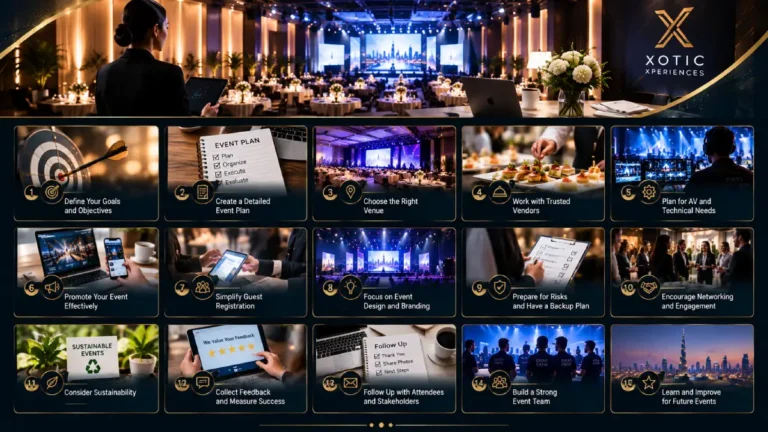
Practical Corporate Event Planning Checklist
- Define the business objective and success metrics
- Identify the target audience and estimate headcount
- Set the budget, including a contingency reserve
- Choose the event format
- Select and contract the venue
- Confirm any required permits and their lead times
- Develop the event concept, branding and programme
- Source and contract vendors and production
- Open invitations and manage registration
- Finalise logistics, staffing and rehearsals
- Deliver the event and manage on-site issues in real time
- Gather feedback, measure results against the original objective, and report
Corporate Event Management Services by Xotic Xperiences
Xotic Xperiences provides corporate event support across the planning, production and execution stages, helping businesses turn an event brief into a coordinated live experience. Its services can cover the core requirements of corporate events, from concept development and venue coordination to production, guest management and on-site execution.
To Wrap Up
Top Event Management Companies in Dubai comes down to a repeatable sequence, a clear objective, a realistic budget, professional coordination across venue and vendors, careful delivery on the day, and an honest measurement of the result. Whether that work is handled internally or by an outside specialist, the events that consistently deliver value are the ones where each of those steps was actually done, rather than assumed.
Frequently Asked Questions
What is corporate event management?
Corporate event management is the end-to-end process of planning, organising, executing and analysing business-related events, from initial concept and budget through production, on-the-day delivery and post-event reporting, aligned with a specific business objective.
What does a corporate event manager do?
A corporate event manager handles event strategy, budgeting, venue selection, vendor management, production oversight, guest management, on-site coordination, risk management and post-event evaluation, so the event serves its business objective and stays within Event Budget Dubai.
What are the types of corporate events?
Common types include conferences, product launches, awards ceremonies, corporate meetings and summits, networking events, employee engagement events, gala dinners and brand activations. Each serves a different business objective and audience.
What is included in corporate event management?
It typically includes concept and strategy, venue and logistics, production (AV, staging, lighting, décor, branding), catering, guest management, vendor coordination, on-site delivery, and post-event reporting, plus risk management and permits where applicable.
How do you plan a corporate event?
Start by defining the objective and audience, then set the budget and format, select the venue, develop the concept and programme, contract vendors, manage invitations and logistics, deliver the event, and measure results against the original objective.
What is the difference between event planning and event management?
Event planning focuses on the preparation phase, concept, budget, venue and vendors. Event management covers the full lifecycle, including production coordination, on-the-day delivery and post-event evaluation. In practice, the two terms are often used interchangeably.
Why hire a corporate event management company?
A management company can save internal time, bring established vendor relationships and specialist expertise, improve production quality and risk management, and provide smoother on-site delivery, particularly for large, complex or high-profile events.
How much does corporate event management cost?
Cost depends on guest count, event format, venue, production level, duration and location, so there is no single figure. The most reliable way to estimate cost is to fix the objective and headcount, then request itemised quotes from several vendors.
What should a corporate event quote include?
A professional quote should itemise planning fees, venue, production, catering, staffing, permits, a contingency reserve, taxes and service charges, payment terms, and a clear list of inclusions and exclusions, rather than a single bundled total.
How do you measure corporate event ROI?
ROI is generally calculated as the value generated by the event minus the total event cost, divided by the total event cost. The specific measure of “value generated,” such as revenue, leads, media reach or retention, should match the event’s stated objective.
What permits are needed for corporate events in Dubai?
Larger or public events in Dubai generally require an event permit from the relevant authority, with additional permits possible for alcohol service, press and media coverage, outdoor structures, or security depending on scale. Requirements and thresholds should be confirmed directly with the venue and licensing authority, as they can change.
How do you choose a corporate event management company?
Look for a track record with similar events, transparent itemised pricing, clear communication with a named point of contact, established vendor relationships, and, for events outside your home market, familiarity with local permit and compliance requirements.