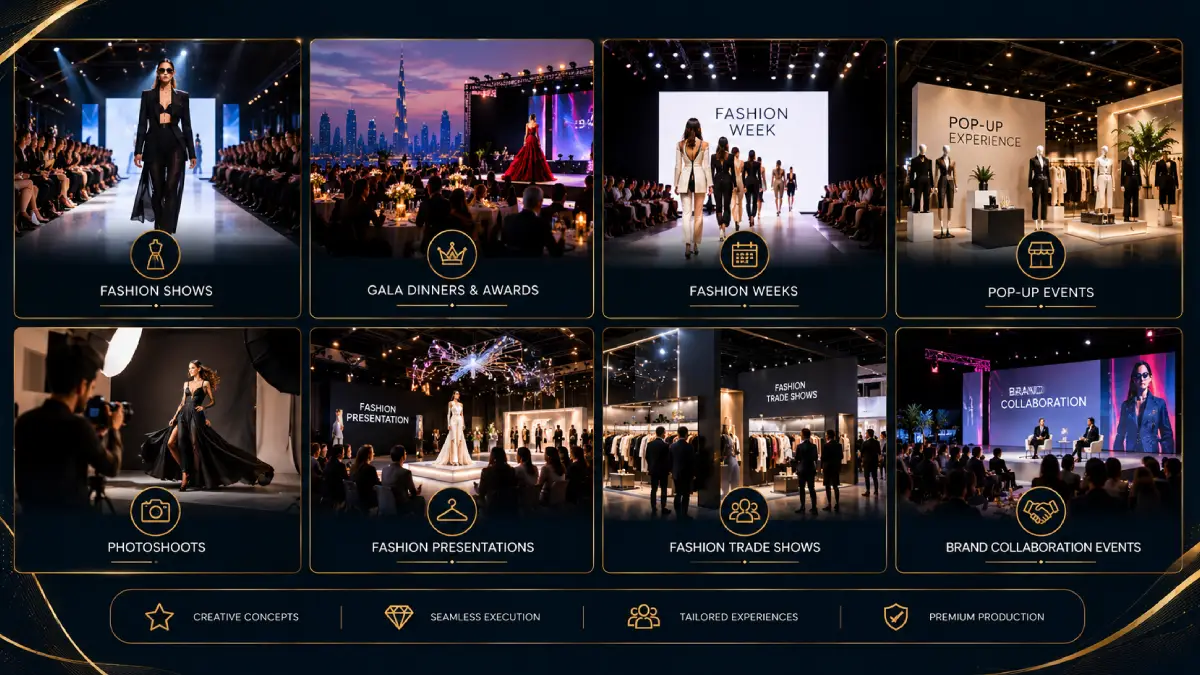
Fashion brands, designers and retailers use different event formats to showcase collections, launch products, introduce designers, connect with buyers, engage customers, generate media attention, build brand awareness and create memorable brand experiences. Fashion events are a broad category. Fashion shows are one format within it, focused on presenting clothing, accessories or collections to an audience.
This guide explains the different types of fashion events, how they differ from fashion shows, and what to consider when planning and producing each format.
What Are Fashion Events?
What are the different kinds of fashion events? A fashion event is an organized experience built around fashion, designers, collections, brands, products or the wider fashion industry. The word “event” covers far more than a runway. A buyer meeting in a showroom, a museum display of historic dress and a charity gala with a fashion show all count.
Common types of fashion events include:
- Consumer-facing, such as pop-up stores and retail shows.
- Industry-focused, such as trade fairs and showrooms.
- Media-focused, such as press previews.
- Brand-focused, such as label launches.
- Entertainment-focused, such as galas and after-parties.
- Sales-focused, such as trunk shows and temporary stores.
Knowing which category your goal falls into makes the choice of format much easier. Fashion events are one segment of the wider field, which also includes different types of event management such as corporate, cultural and entertainment formats.
10 Types of Fashion Events
The table below gives a quick overview. The sections that follow explain each format.
| Event type | Main purpose | Typical audience | Runway typically required? |
| Fashion or runway show | Present a collection. | Media, buyers, influencers, guests. | Usually. |
| Fashion week | Showcase many designers in one week. | Buyers, media, industry. | Often. |
| Collection launch | Introduce a new line. | Media, VIPs, influencers. | Optional. |
| Brand launch | Introduce a label or market entry. | Media, partners, guests. | Optional. |
| Trade show or fair | Do business and source products. | Buyers, retailers, suppliers. | No. |
| Exhibition | Educate and display. | Visitors, enthusiasts. | No. |
| Press event | Win coverage. | Journalists, editors, bloggers. | Optional. |
| Pop-up event | Sell and engage. | Consumers. | No. |
| Charity event | Raise funds. | Donors, guests, supporters. | Optional. |
| Corporate event | Build relationships. | Partners, staff, VIPs. | Optional. |
Fashion Shows and Runway Shows
A fashion show is the format most people picture. Models present a designer’s collection, usually on a runway, while lighting, music and staging support the clothes. The runway design gives the show its visual identity.
Media, buyers, influencers and guests may attend. The goal is to present a creative vision, build interest and, for many designers, generate orders and press coverage. Shows range from large productions to small, intimate presentations.
Fashion Week Events
A fashion week is typically a multi-day series of shows, presentations and related events of shows and presentations in one city, usually organized around seasonal collections. It brings designers, buyers and media together in one place.
Fashion week usually includes:
- Multiple designer shows and runway presentations
- Seasonal collections
- Industry networking and media events
- Brand activations
- After-parties and related experiences
For many labels, a fashion week slot is as much about industry visibility as the show itself.
Designer Collection Launches
A collection launch introduces a specific line or capsule. Designers can choose from several formats:
- Runway presentations
- Private previews
- VIP events
- Media previews
- Experiential launches
- Influencer events
Launches are often timed ahead of retail availability to build anticipation. They also suit brands that want a tailored experience rather than a full runway, which is where broader launch-event support becomes useful.
Fashion Brand Launch Events
A brand launch is different from a collection launch. A collection launch presents a line, while a brand launch presents the label itself, or a significant change to it. It might introduce:
- A new fashion label.
- A new market.
- A new retail concept.
- A new product line.
- A collaboration.
These events rely on branding, storytelling and guest experience. Media coverage and production quality matter because the event sets first impressions. Brands that need help creating this kind of experience often look at brand activation services.
Fashion Trade Shows and Trade Fairs
Trade shows are generally industry-oriented. They focus on business, sourcing and networking rather than spectacle, and many are not open to the public.
Typical participants include:
- Fashion brands and designers.
- Buyers and retailers.
- Manufacturers and suppliers.
- Media and industry professionals.
Trade shows are generally business-focused, although some also include consumer-facing elements. and it does not need a runway. Exhibitors do need strong booths, so exhibition stand design and build is a major part of success at these fairs.
Fashion Exhibitions
A fashion exhibition is a curated display rather than a timed performance. It may show:
- Clothing and accessories.
- Historical pieces.
- Designer collections.
- Fashion photography.
- Textile work.
- Artistic installations.
Visitors explore at their own pace. The experience centers on viewing and learning, unlike a runway show, where the audience watches a scheduled sequence.
Fashion Press Events
Press events are designed for the people who shape coverage:
- Journalists and fashion editors.
- Bloggers and influencers.
- Photographers and media outlets.
Common formats include press previews, collection previews, media breakfasts, private presentations and product reveals. The aim is to explain the collection and brand story so that coverage is accurate and well informed.
Fashion Pop-Up Events
Pop-ups are temporary fashion experiences. They include pop-up stores, temporary showrooms, collection previews, interactive brand experiences and mall activations.
Brands use them to test a market, create urgency, drive direct sales and generate social buzz. Because they are short-lived, they work well for limited drops and new-market entry.
Fashion Charity Events
Fashion can also support a cause. Examples include charity fashion shows, fundraising galas, designer collaborations, auctions and awareness campaigns. The Met Gala is a prominent example of a fashion-focused fundraising event associated with the Metropolitan Museum of Art’s Costume Institute.
These events combine glamour with a clear fundraising objective. Guest experience and storytelling usually matter as much as the clothes.
Fashion Corporate Events
Fashion brands and retailers also run business-focused gatherings, such as brand anniversaries, partner events, retailer events, VIP gatherings, employee experiences and industry networking events. They are typically smaller and more relationship-driven than a runway show.
6 Types of Fashion Shows
Fashion shows can also be categorized by their audience, purpose, scale and presentation style.
Luxury Fashion Shows
Luxury shows are high-production runway or presentation formats staged by luxury houses. They emphasize exclusivity, high-profile guests and strong media coverage.
Designer Collection Launches
As a show format, a collection launch is a runway or presentation dedicated to one collection. It can be part of a fashion week calendar or stand alone.
Fashion Brand Events
Some shows sit inside a larger brand launch or activation. These are storytelling-heavy, with the show supporting a wider message.
Seasonal and Runway Shows
Traditional spring/summer and fall/winter runway shows form the core of fashion week calendars. Designers present each season’s collection to buyers and press.
Retail and Commercial Fashion Events
These include in-store shows, trunk shows and department-store presentations. They are aimed at consumers and buyers and tend to be closer to the point of sale.
Private and Exclusive Fashion Events
Invitation-only showcases serve VIP clients, top buyers or selected media. Many have no public runway at all, which creates a more personal experience.
Fashion Event vs. Fashion Show: What’s the Difference?
People often use the two terms interchangeably, but they are not the same thing.
| Fashion Event | Fashion Show |
| Broad category | Specific type of fashion event. |
| Can include launches, exhibitions and trade shows | Primarily showcases fashion collections. |
| May focus on networking or sales | Usually focuses on presentation. |
| Can have many different formats | Usually has a structured presentation. |
| May or may not use a runway | Often uses a runway or presentation space. |
All fashion shows can be considered fashion events, but not all fashion events are fashion shows.
How to Choose the Right Type of Fashion Event
The right format depends on what you want the event to do, who needs to attend and what you can produce well.
Consider Your Objective
Start with the goal.
| Objective | Suitable formats | Production complexity |
| Launch a collection | Runway show, launch event, press preview. | Medium to high. |
| Generate media coverage | Press event, fashion week show. | Medium to high. |
| Sell products | Pop-up, trunk show, retail event. | Low to medium. |
| Meet buyers | Trade show, showroom, buyer presentation. | Medium. |
| Build brand awareness | Brand launch, pop-up, activation. | Medium to high. |
| Create a luxury experience | Private show, gala. | High. |
| Engage customers | Pop-up, interactive brand event. | Low to medium. |
Consider Your Audience
Different formats suit different guests. Consumers respond to pop-ups and retail shows. Buyers and retailers go to trade shows and showrooms. Media and influencers attend press events and launches. VIP guests and industry professionals are often better served by private shows and galas.
If the guest list is mixed, you may need a main show plus a smaller session, such as a media preview.
Consider Your Budget and Production Requirements
Budget shapes scale. Large runway shows and fashion week slots need the most resources. Collection launches and press previews sit in the middle. Trunk shows, in-store presentations and small pop-ups are lighter.
Whatever the format, plan for these items:
- Venue
- Staging
- Lighting
- AV
- Models and styling
- Backstage
- Guest management
- Photography and video
What Goes Into Producing a Fashion Event?
Production follows a clear workflow. A typical fashion-event production workflow runs from the initial brief and discovery through concept development, venue planning, runway and production design, rehearsals, show-day management and wrap-up. venue planning, runway and production design, rehearsals, show-day management and wrap-up.
Concept Development
The concept sets the theme, story, objectives and audience. Every later decision refers back to it.
Venue and Space Planning
The venue must suit the theme, hold the guest count and support the technical needs. In Dubai, this includes confirming venue permissions early.
Runway and Stage Design
The runway’s shape, elevation and backdrop affect sightlines and how models move. A good design also keeps guests and photographers in the right places.
Lighting and Sound
Lighting sets the mood and highlights the garments. Sound and music are timed to each look, and cues have to be rehearsed.
Model and Backstage Coordination
Casting, fittings, line-up and quick changes are managed backstage. A stage manager keeps the order and timing under control.
Guest Management
Invitations, RSVPs, seating, VIP flow and accreditation shape how the audience experiences the event. Media and influencer coordination also sits here.
Branding and Visuals
Signage, digital screens and social media integration carry the brand across the venue. They should match the concept rather than compete with it.
Rehearsals
A rehearsal tests model timing, cues and technical systems before the audience arrives. It is where most problems are found and fixed.
Show-Day Production
On the day, a run-of-show and show caller keep every department on cue. Issues are resolved quietly so the audience never sees them.
Fashion shows need lead time. Fashion shows often require several months of preparation, particularly when they involve custom staging, fabrication, model casting, venue approvals and complex technical production. Large, fashion-week-scale productions may need longer.
Teams planning a full runway often use specialist fashion show production support to coordinate design, lighting, sound, models and show calling.
Fashion Events in Dubai
Dubai hosts a range of fashion-event formats, including designer showcases, luxury fashion events, brand launches, runway shows, retail activations, fashion exhibitions and collection launches.
Venues include hotels, malls and dedicated event spaces. Public fashion shows generally need approvals from the relevant authority, plus venue-specific permissions. Requirements change, so confirm current rules with the authorities or your production partner before you commit.
Working with an experienced Event Management Company in Dubai can simplify venue coordination, permits and production across the UAE.
Xotic Xperiences provides fashion show event planning and production in Dubai and across the UAE. Its team coordinates runway design, staging, lighting, sound, model coordination, backstage operations, guest management and show-day execution. You can read more about its fashion show event management in Dubai and see past work in the event management portfolio.
To Wrap Up
Fashion events can take many forms, from runway shows and designer showcases to collection launches, trade fairs, exhibitions, press events and brand activations. The right format depends on the brand’s objectives, audience, collection and desired experience. Match those four factors first, and the production decisions become much easier.
Frequently Asked Questions
What are the different kinds of fashion events?
The different kinds of fashion events include runway shows, fashion weeks, collection launches, brand launches, trade shows, exhibitions, press events, pop-ups, charity events and corporate events. Each serves a different goal and audience.
What are the different types of fashion shows?
Common fashion show types are luxury shows, designer collection launches, brand events, seasonal runway shows, retail and commercial events, and private or exclusive showcases.
What are the most common types of fashion events?
The most common are runway shows, fashion weeks, collection launches, trade shows, pop-up stores and press previews.
What is the difference between a fashion event and a fashion show?
A fashion event is the broad category. A fashion show is one format within it. Not every fashion event includes a runway.
What is a runway fashion show?
A runway fashion show presents clothing and accessories on models walking a runway. Lighting, music and staging support the collection, and the audience may include media, buyers and guests.
What is a fashion trade show?
A fashion trade show is an industry event where brands, designers, buyers, retailers and suppliers do business and network. It is mainly business-to-business and often closed to the public.
What happens at a fashion exhibition?
Visitors view curated displays such as clothing, accessories, historical pieces, photography or installations. The focus is on exploring and learning, not a timed runway presentation.
What is a fashion collection launch?
A collection launch introduces a new line or capsule. It may be a runway show, private preview, VIP event, media preview or influencer event.
How do you organize a fashion show?
Start with the concept, then secure the venue and design the runway. Next, cast the models, plan lighting, sound and guest management, and hold a rehearsal before show day.
What is the difference between a fashion show and a fashion exhibition?
A fashion show is a scheduled presentation in which models or presenters showcase clothing and collections, while a fashion exhibition is a curated display that visitors typically explore at their own pace.