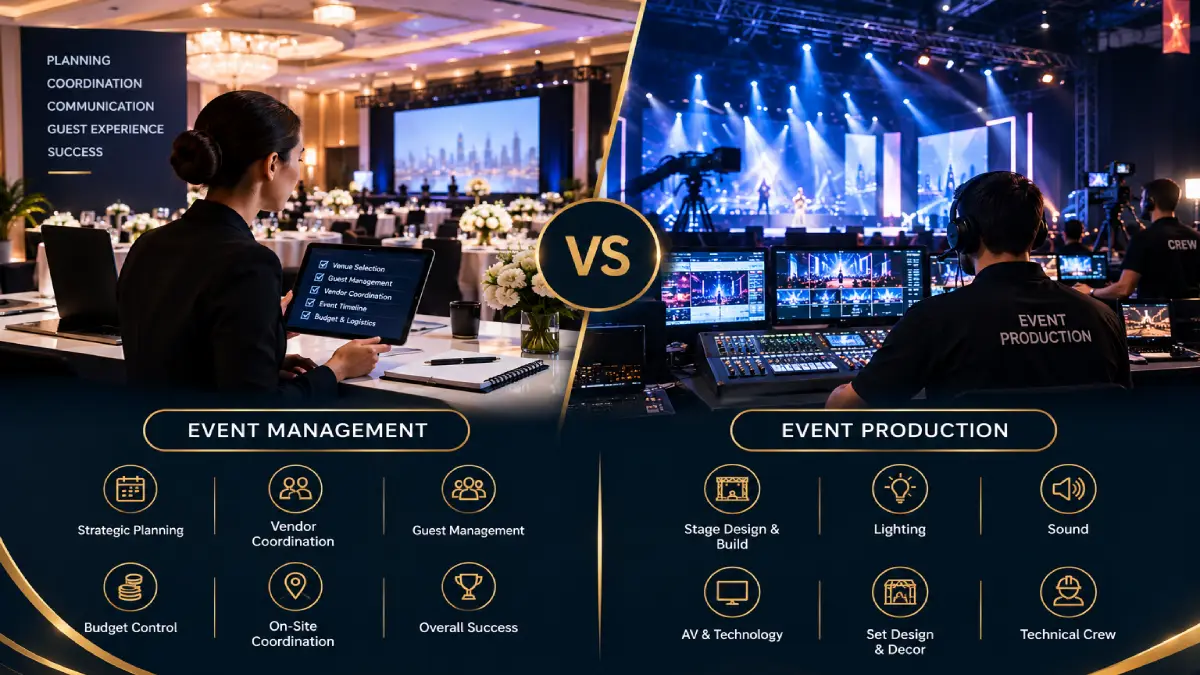
Event management and event production are closely connected, but they are not exactly the same. Event management covers the broader planning, coordination and execution of an event. Event production focuses more specifically on the technical, creative and physical delivery of the live experience. The difference between event management and event production often becomes important when clients compare proposals and need to understand why scopes, responsibilities and fees differ.
Most successful events need both functions. That applies to:
- Corporate conferences
- Award ceremonies
- Product launches
- Brand activations
- Exhibitions
- Concerts
- Fashion shows
The boundary is not fixed. At a small seminar, one event manager may handle the production personally. At a large conference or concert, management and production usually run as separate workstreams led by different teams. Some agencies deliver both under one contract, and others specialize in one.
What Is Event Management?
Organizations that want one partner to carry this whole responsibility often work with an Event Management Company in Dubai. It starts with the question of what the event is meant to achieve and continues until results have been measured. Industry guides such as Cvent describe it as a lifecycle that runs from initial planning through post-event reporting.
Event management is also wider than event planning. Planning decides what should happen. Management keeps going by coordinating people, suppliers, decisions, problems and outcomes while the event is being delivered. Organizations that want one partner to carry this whole responsibility often work with an Event Management Company in Dubai that combines planning, venue coordination, supplier management, production, rehearsals and event-day execution. The different types of event management also vary in scope, from corporate meetings to public shows.
What Does Event Management Include?
The responsibilities fall into a few groups.
| Area | What the event manager handles |
| Purpose | Event concept and objectives, audience definition |
| Resources | Budget planning, venue sourcing, permits and approvals |
| Time | Event timelines and schedules. |
| People | Vendor coordination, guest management, speaker and talent coordination. |
| Experience | Catering, branding, entertainment. |
| Operations | Logistics, event-day coordination. |
| Results | Post-event activities such as feedback, reporting and follow-up. |
A manager who starts with a clear objective, such as generating leads or launching a product, can make every later decision against it.
What Is Event Production?
Production in events is not equipment rental. Put simply, it is everything the audience sees, hears and moves through, and everything that has to work behind the scenes for that to happen.
For readers looking for the event production meaning or definition, production can involve:
- Stage design and staging
- Lighting and sound
- AV, LED screens and video production
- Rigging and special effects
- Technical equipment and crew
- Show calling, rehearsals and cue management
- On-site production
Production in events is not equipment rental. A rental company supplies gear. A production team designs the system, integrates it, tests it, staffs it and operates it live. It is also not only an event-day activity. Site surveys, technical drawings, content deadlines and rigging approvals often begin months before the event opens.
Event Management vs. Event Production
The table below shows how the two functions differ in emphasis.
| Aspect | Event Management | Event Production |
| Primary focus | Overall event delivery | Technical and creative execution |
| Planning | Objectives, budget, venue, timeline | Technical plans, drawings and specifications |
| Suppliers | Coordinates the wider vendor network | Coordinates production suppliers and crews |
| Guest experience | Registration, hospitality and logistics | Stage, sound, lighting, screens and show flow |
| Event day | Overall operations | Technical and show execution |
| Post-event | Reporting, feedback and wrap-up | Strike, equipment removal and technical closeout |
In short, event management is broader event coordination, while event production is technical, creative and physical execution.
Do not read this as two departments that exist separately in every company. Responsibilities overlap depending on the agency and the event. Both sides manage suppliers and schedules, and both solve problems on site. The phrase “management plans and production executes” is too simple, because managers also run live operations and producers work throughout pre-production.
How Do Event Planning and Production Work Together?
The Event Planning and Production: How Do They Work Together? question is best answered by looking at a full workflow. The two teams share decisions from the first brief to the last strike.
| Stage | What happens |
| 1. Event Brief | Client objectives, audience, date, location and budget. |
| 2. Event Planning | Concept, venue, suppliers, guest journey and schedule. |
| 3. Creative Development | Theme, stage concept, branding, visuals and experience. |
| 4. Production Planning | Technical drawings, staging, lighting, AV, sound, LED and equipment. |
| 5. Pre-Production | Vendor coordination, fabrication, rehearsals and technical checks. |
| 6. Event Setup | Load-in, installation, testing and venue preparation. |
| 7. Live Event Production | Show calling, cues, speakers, performers, lighting, sound and AV. |
| 8. Event Breakdown | Dismantling, equipment removal and post-event wrap-up. |
Consider a product launch. The manager confirms the objective, sets the budget, secures the venue and coordinates guests, media and executives. The production team turns the brand concept into a stage and visual environment, specifies microphones, cameras and LED screens, runs rehearsals and calls the reveal.
The two need each other’s information early. The manager needs production details to finalize the budget, venue and risk plan. The producer needs to know the audience, access times and agenda. Production also influences choices that seem to belong to planning, such as ceiling height, stage dimensions, power availability and sightlines.
What Is Production in Event Management?
Depending on the event, it may be delivered by an in-house team, an agency, the venue or an outside production company. A simple hierarchy shows where it sits:
| Level | Element |
| Event management | Overall coordination. |
| Planning | Budget, venue, vendors, guests, logistics. |
| Production | Staging, sound, lighting, video, technical delivery. |
| Event-day coordination | Operations, guests, suppliers, contingencies. |
Production takes the approved event concept and turns it into the physical event environment. Depending on the event, it may be delivered by an in-house team, an agency, the venue or an outside production company.
What Does an Event Production Team Do?
A production team converts a creative brief into specifications that can be built, tested and run. Job titles vary between companies, but an event producer usually leads the creative and technical realization, a production manager handles schedules and suppliers, and a technical director oversees the systems.
1. Stage Production
The team designs and builds the stage, backdrop, set elements, podiums and stage furniture. The design has to look right, but it also has to be safe, buildable and suited to the venue.
2. Audio Production
Audio covers PA systems, microphones, mixing and speaker systems. Sound checks confirm that every presenter can be heard clearly, including from the back of the room.
3. Lighting Production
Lighting includes stage lighting, architectural lighting, moving lights and show lighting. A programmer builds the lighting looks and transitions that carry the mood of the event.
4. Video and LED Production
This area covers LED screens, video walls, projection, content playback, camera systems and live feeds. Content has to be collected early, since late files are a frequent cause of problems on the day.
5. Technical Production
Technical production includes equipment, technical crew, power, rigging, technical rehearsals and show control. Power planning and rigging approval decide which venues are feasible in the first place.
6. Show Calling
The show caller reads the run-of-show and issues cues so that departments move together. A typical sequence runs from speaker to video, lighting, sound, stage and performer.
Event Management vs. Event Production, Key Differences
The key differences between event management and event production come down to five areas:
- Scope. Event management is broader. Production is a specialized component.
- Focus. Management focuses on overall delivery. Production focuses on how the experience is technically and physically delivered.
- Responsibilities. Management coordinates the complete event ecosystem. Production coordinates technical and creative execution.
- Teams. Event managers coordinate venues, suppliers, guests and logistics. Production teams include technicians, stage managers, AV specialists, lighting teams and show callers.
- Timing. Management starts early in planning and continues through wrap-up. Production becomes especially intensive during pre-production, setup, rehearsals and the live event.
Do You Need Event Management or Event Production?
The answer depends on complexity, not on which label sounds better.
| You may need | If |
| Event management | You need someone to organize the entire event, coordinate the venue and suppliers, manage guests and logistics, handle budgets and timelines, or oversee multiple vendors. |
| Event production | Planning is already covered, but the event needs complex staging, professional AV, lighting and sound, LED or video production, technical rehearsals or show calling. |
| Both | You are producing a large conference, a concert, a major product launch, a large brand activation, an awards ceremony or a fashion show. |
For technically complex events, look at specialist services such as conferences and awards, concert and live show event management and brand activation services in Dubai. If your event includes a booth or display, exhibition stand design and build covers the fabrication side.
Before signing, ask each agency to state whether the proposal includes overall event management, production management, technical direction, AV equipment, staging and set, lighting, video and content playback, crew, rehearsals, show calling, venue technical coordination, load-in and load-out, and backup systems. Two quotes that look alike often differ on exactly these items. To compare providers, see the list of event management companies in Dubai and the event management portfolio for examples of delivered work.
Closing Remarks
Event management and event production are different but interconnected functions. Event management coordinates the overall event, while event production turns the creative plan into a live, technical and physical experience. For complex events, both need to work together from planning through event-day execution.
Frequently Asked Questions
What is event production?
Event production is the creative and technical process of turning an event concept into a live experience. It can include staging, audio, lighting, video, set design, power, rigging, technical crew, rehearsals and show control.
What is the difference between event management and event production?
Event management covers the whole event, including objectives, budget, stakeholders, logistics, guests, suppliers and evaluation. Event production covers the technical, creative and physical delivery of the live experience. In the Event Management vs. Event Production comparison, management is broader and production is more specialized.
Is event production part of event management?
Often, yes. Production is commonly treated as a specialist function within event management, though it may be handled by an internal team, a venue or a separate production company.
What does an event production company or team do?
An event production company handles the technical, creative, and physical execution of a live event. While event planners focus on strategy, guest lists, and catering, production teams focus on making the show look, sound, and run seamlessly.
What is production in event management?
It is the part of the event-management process that turns the approved concept into the physical and technical event environment.
What is the meaning of event production?
It means the technical and creative delivery of an event experience, from design and equipment through rehearsal and live operation.
Do conferences need event production?
Most do. Even a simple conference needs sound, presentation playback and lighting, and larger ones add cameras, livestreaming and show calling. A small meeting with reliable venue AV may need very little.
How early should event production planning begin?
It depends on the complexity of the event, the venue, fabrication lead times and technical requirements. Complex events with custom staging or rigging should involve production during concept and venue selection.