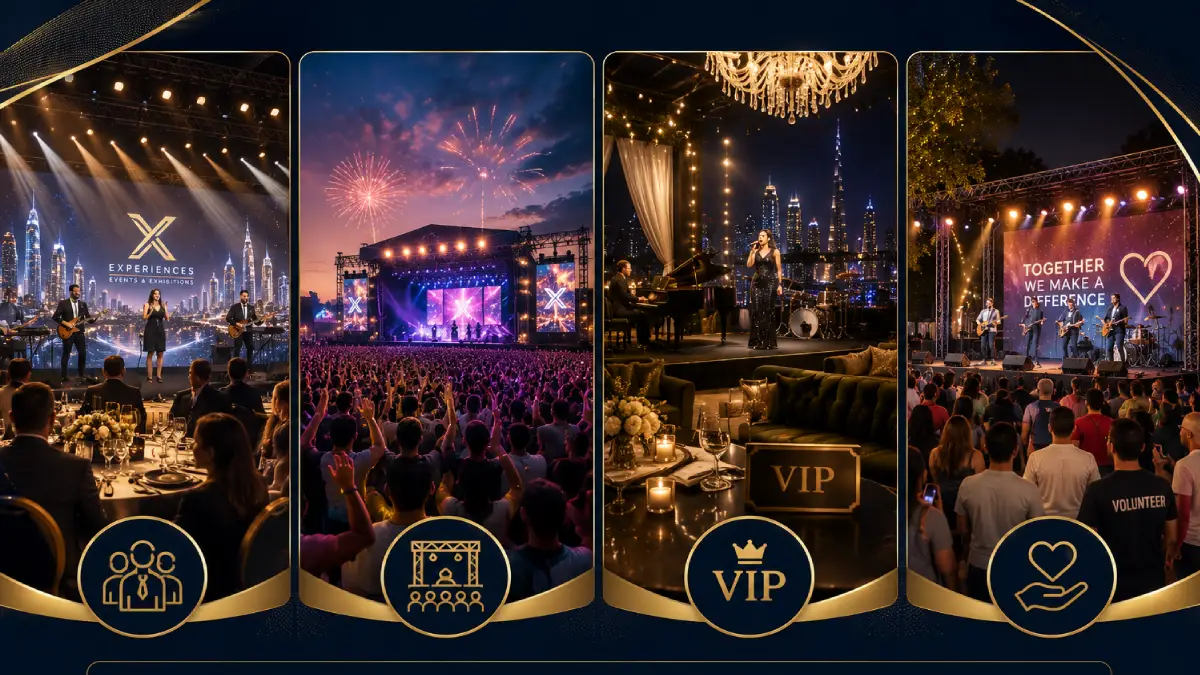
Get a suggestion from ten different people what “a concert” means and you’ll get ten slightly diverse pictures, a stadium show with pyrotechnics, an intimate acoustic set in a hotel lounge, a weekend festival with mud on your boots, or a company gala with a surprise headliner after the awards. All of them are accurate. The phrase “concert” covers an enormous range of formats, and most guides online only tell half the story because they sort concerts by music genre (rock, pop, EDM, jazz) rather than by what the event is actually for.
What Are the Different Types of Concerts
Different types of concerts are usually organized around four main purposes: corporate concerts (business-organized entertainment for employees, clients, or stakeholders), music festivals and public concerts (large-scale events open to general ticket buyers), private and VIP shows (exclusive, invitation-only performances), and charity and community events (fundraising or community-focused concerts).
Concerts also form part of the wider different types of event management, with planning requirements changing depending on the audience, purpose, venue, and scale of the event.
The 4 Main Types of Concerts
Here are four main, and best types of concerts, explained:
1. Corporate Concerts
This is one of the best types of concerts, which is known as an entertainment organized and paid for by a company, generally built around a particular commercial goal instead of a pure entertainment. Think employee appreciation nights, company anniversaries, product launch afterparties, shareholder events, or client hospitality evenings.
Scale swings wildly here, a 50-person executive briefing with a solo acoustic act and a 1,000-person company milestone celebration with a complete production headliner are both “corporate concerts.” For corporate events that combine entertainment with presentations, choosing suitable conference themes in Dubai can also help create a more cohesive experience around the concert.
2. Music Festivals and Public Concerts
This is what most people picture when they hear “concert,” an event open to anyone willing to buy a ticket. It ranges from a single-artist arena show to a multi-day, multi-stage festival with dozens of acts.
What both share is the commercial model, tickets are sold to the general public, and the production has to be built to handle unpredictable crowd behavior at real scale, from entry management to emergency planning.
3. Private and VIP Shows
Private and VIP concerts flip the access model entirely. Instead of anyone being able to buy a ticket, the guest list is closed, invitation-only, curated, and often small. This category covers everything from a private performance at a wedding or milestone birthday to VIP packages layered onto a public concert (meet-and-greets, premium viewing platforms, backstage tours) to closed-door showcases for high-net-worth clients.
The defining features are personalization and discretion. Stage visuals, hospitality, and even the artist’s set can be tailored to the occasion in a way that’s simply not possible at a 15,000-seat public show.
4. Charity and Community Events
Charity and community concerts exist to raise money or bring people together around a cause, not to turn a profit. Fundraising galas, benefit concerts for a foundation, and free community concerts in public spaces or malls all fall into this bucket.
Artists frequently perform at reduced fees or pro bono to support the cause, ticket pricing (where it exists at all) is often donation-based, and the programming tends to be broader and more family-friendly than a commercial show, mixing music with spoken word, comedy, or local performers to draw a wider crowd. Production is usually scaled to the budget available rather than the other way around.
How Are These Concert Types Different
| Concert Type | Main Purpose | Typical Audience | Scale |
| Corporate Concerts | Corporate entertainment | Employees, clients, guests. | Small to large. |
| Music Festivals & Public Concerts | Public entertainment | General public. | Medium to large. |
| Private & VIP Shows | Exclusive entertainment | Private/VIP guests. | Small to medium. |
| Charity & Community Events | Fundraising & engagement | Community/public. | Small to large. |
Looking a level deeper, the differences show up in venue choice, production style, and how the budget is structured too:
| Concert Type | Access | Venue Style | Production Focus | Cost Structure |
| Corporate Concerts | Invitation-only | Offices, hotels, exhibition venues. | Branding-integrated production. | Company-funded. |
| Music Festivals & Public Concerts | Open ticket sales. | Arenas, stadiums, amphitheaters, festival grounds. | Large-scale, multi-stage (for festivals). | Ticket revenue-driven. |
| Private & VIP Shows | Curated guest list. | Premium venues, private lounges, estates. | Highly personalized production. | High cost per guest. |
| Charity & Community Events | Open or donation-based. | Community spaces, public venues. | Scaled to available budget. | Donations, sponsorships, pro bono artists. |
How to Choose the Right Type of Concert
Choosing the type of concert format follows the objective, not the other way around. Before locking in a direction, it helps to run through a short list of practical questions:
- What’s the actual goal? Employee engagement or client entertainment points to a corporate concert. Broad public reach points to a festival or public show.
- Who is the audience, and how many of them are there? A guest list of 50 to 500 fits comfortably into a corporate, private, or community format.
- How is it funded? Company budget, ticket sales, per-guest premium spend, and donations/sponsorships all lead to very different production plans.
- What venue fits the vision? A hotel ballroom or private estate suits an intimate format; an arena or amphitheater is built for scale.
- How personalized does the guest experience need to be? The more tailored the experience (branding, meet-and-greets, custom hospitality).
What Goes Into Successful Concert Management
Regardless of which type you’re organizing, the same operational building blocks show up behind the scenes. Whether you’re planning a corporate concert, festival, or concert & live show, skipping any one of them can create problems on event day.
Concert Planning: In a market like Dubai, mid-to-large productions typically need 8 to 12 weeks of lead time to account for venue permits and vendor scheduling, while smaller, simpler events can sometimes come together in 4 to 6 weeks.
Venue Selection: Capacity, indoor versus outdoor, technical capability (power, rigging, acoustics), and accessibility all need to be assessed against the concert type before a venue is booked, not after.
Artist and Performer Coordination: Booking, contract negotiation, rider management, and, for international acts, visas, travel, and accommodation all sit here. This is also where hospitality expectations for the artist get set.
Stage Production: Stage design, layout, LED screens, and for corporate events, branding integration into the visuals, all built with safety and structural integrity as the non-negotiable baseline.
Sound and Lighting: International-standard audio systems tuned to the specific venue, paired with lighting design that matches the mood and scale of the event.
Event Branding: Relevant mainly to corporate and, to a lesser extent, private events, logo placement, thematic storytelling through stage visuals, and visual consistency across every touchpoint.
Audience and Guest Management. Registration, ticketing or invitation verification, entry and exit flow, and VIP handling where applicable.
Security and Crowd Management: Security staffing, access control, and emergency planning should be scaled to the size of the crowd and aligned with local safety standards. Knowing what is crisis management in events? can also help organizers prepare for unexpected incidents and establish clear response procedures.
Event-day Production. The real test, technical checks, show calling, and real-time troubleshooting so that everything planned over the preceding weeks actually holds together on the night.
Concerts in Dubai What Should You Consider
Dubai’s concert market is shaped by an unusually mixed audience, international tourists and business travelers, a strong local Emirati and wider Arab audience, a large South Asian expat community, and a sizeable Western expat base, all with different genre preferences and expectations.
Venue choice in the city typically comes down to indoor versus outdoor, and both are well represented:
| Venue | Type | Indoor/Outdoor | Best Suited For |
| Coca-Cola Arena (City Walk) | Indoor arena, roughly 17,000 capacity. | Indoor. | Major international touring acts. |
| Dubai Opera (Downtown) | Concert hall / auditorium. | Indoor. | Seated, cultural, classical, jazz performances. |
| Dubai World Trade Centre | Exhibition venue. | Indoor. | Summer concerts, indoor festivals. |
| Dubai Media City Amphitheatre | Outdoor amphitheater, 10,000+ capacity. | Outdoor. | Festivals and large-format gigs, best from October. |
| Dubai Millennium Amphitheatre (Expo City) | Outdoor amphitheater. | Outdoor. | Touring acts, mid-to-large concerts. |
| Ushuaïa Dubai Harbour | Open-air beach club. | Outdoor. | Electronic music, high-energy shows. |
Seasonality plays a real role in planning. October through April is the window for outdoor concerts and festivals, when temperatures make an evening outdoors comfortable. From May through September, outdoor production shifts indoors or into malls, Dubai Summer Surprises, for instance, runs free concerts in mall settings through the hottest months.
How Much Does It Cost to Organize a Concert
- Artist or Performer Fees: The single biggest swing factor, ranging from pro bono (charity events) to seven figures for A-list bookings
- Venue Rental: Indoor arenas, outdoor amphitheaters, and hotel spaces all price differently
- Number of Attendees: More guests means more staffing, security, and infrastructure
- Stage, Sound, and Lighting: Technicality of design, LED and video elements, and whether branding integration is required
- Security and Staffing: Scales directly with crowd size and event duration
- Marketing and Ticketing: Relevant mainly to public concerts and festivals
- Event Duration: Single night versus multi-day festival changes almost every other cost line
Why Work With a Professional Concert Management Company
A concert is one of the few events where dozens of moving parts, artist logistics, permits, structural staging, live sound, crowd safety, all have to land correctly on one specific night, with no do-over.
That’s the real argument for professional management: not that it guarantees a flawless show (nobody can promise that), but that it puts one accountable team in charge of coordinating vendors, managing the timeline, and staying compliant with local safety and permit requirements.
Concert Management Services by Xotic Xperiences
Xotic Xperiences is a Dubai-based event management company that has delivered 100-plus events since 2022, ranging from 50-person executive briefings to productions of over 1,000 attendees, working with corporate teams, government entities, and international brands across Dubai, Abu Dhabi, and the wider UAE.
Its concert services cover corporate concerts, public events, private shows, and charity events, with expertise in concept development, stage production, sound and lighting, branding, security, and event-day execution. The company also manages UAE permits, safety compliance, and international performer logistics.
If you’re planning a concert in the UAE and want a team that manages the process end to end, you can review the specifics of their concert management services in Dubai directly.
Wrapping Up
Concerts aren’t a single format; they serve different objectives, audiences, and budgets. Corporate concerts focus on business relationships, while public concerts and festivals serve larger audiences. Private and VIP shows prioritize exclusivity, while charity and community events support a cause. Choosing the right format from the start helps everything else, from venue and budget to production, fall into place.
Frequently Asked Questions – FAQs
What are the different types of concerts?
Different types of concerts can be classified by genre, venue, format, or purpose. The most practical framework for planning is purpose-based: corporate concerts, music festivals and public concerts, private and VIP shows, and charity and community events.
What are the four main types of concerts?
The four main types are corporate concerts (business-organized events for employees and clients), music festivals and public concerts (large-scale events open to the general public), private and VIP shows (exclusive performances for invited guests), and charity and community events (fundraising and community-focused performances).
What is a private concert?
A private concert is an exclusive, invitation-only performance rather than a publicly ticketed show. It typically involves a curated guest list, personalized production, premium hospitality, and a much higher cost per guest than a public concert.
What are charity concerts?
Charity concerts are events organized to raise funds or awareness for a cause. Artists often perform at reduced fees or pro bono, ticketing is frequently donation-based or free, and programming tends to be diverse and family-friendly to draw a broad, community-oriented audience.
What is the difference between a concert and a festival?
A concert is typically a single-stage event featuring one headliner, sometimes with support acts, running for one night. A festival features multiple artists across multiple stages, often over several days, and requires significantly more complex scheduling and logistics.
How much does it cost to organize a concert?
Cost depends on artist fees, venue, attendee numbers, production complexity, security, staffing, and event duration. There’s no fixed industry price, costs vary significantly by concert type and scale.
What services are needed to organize a successful concert?
A concert that is successful requires good planning, well-known, and impressive artists, right venue selection, performer coordination, stage production, sound and lighting, event branding (for corporate events), audience and guest management, security and crowd management, and event-day production.