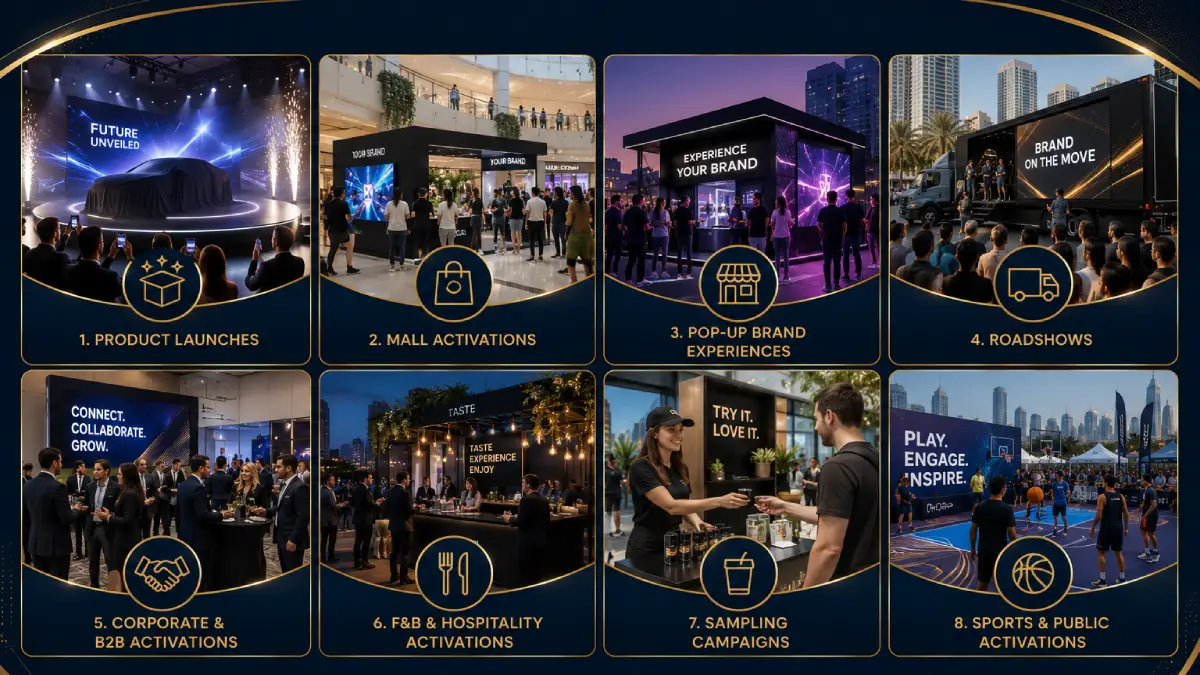
Before you direct start discussing the types of brand activation, you must first have a deep knowledge of brand activation events and why to organize them. On the other side of the coin, most popular 8 types of brand activation events are:
- Product Launches
- Mall Activations
- Pop-Up Brand Experiences
- Roadshows
- Corporate & B2B Activations
- F&B & Hospitality Activations
- Sampling Campaigns
- Sports & Public Activations
Table of Content
- Different Types of Brand Activation: Events and Campaigns Around You
- What Is a Brand Activation?
- What Are the Different Types of Brand Activation?
- 8 Types of Brand Activation
- Brand Activation Ideas for Different Marketing Goals
- Creative Brand Activation Ideas
- Digital Brand Activation Examples
- How to Choose the Right Brand Activation Type
- Conclusion
- Frequently Asked Questions
Different Types of Brand Activation: Events and Campaigns Around You
Walk through Dubai Mall on a Thursday evening and you’ll pass at least one brand doing something other than selling. A pop-up handing out samples near Fashion Avenue. A stage set up outside Reel Cinemas for a product reveal. A QR code on a wall that turns into an AR filter when you scan it. None of that is advertising in the traditional sense – nobody’s interrupting your scroll or your drive time. You’re choosing to walk over and take part. That’s brand activation, and it’s become one of the fastest-growing categories in marketing budgets worldwide.
Most brand activation agencies in Dubai with sufficient budget do not compromise on their brand persona.
Marketing Dive reported in late 2024 that 80% of companies had increased their experiential marketing spend, with activations now eating up 10–30% of total marketing budgets. In the UAE, the event management market was valued at roughly USD 9.6 billion in 2025 by different types of event management companies and is forecast to reach USD 27.4 billion by 2034, per IMARC Group – a sign of how much brands here are betting on live, in-person engagement over pure media spend. Splash That’s 2024 research found 77% of marketers believe experiential events outperform digital advertising, email, and content marketing combined. People remember what they did more than what they watched.
But “brand activation” isn’t one thing. It stretches from a five-minute sampling interaction at a mall kiosk to a three-day roadshow across four emirates. This guide covers the eight main types – product launches, mall activations, pop-up experiences, roadshows, corporate and B2B activations, F&B and hospitality activations, sampling campaigns, and sports and public activations – along with ideas for each and how to pick the right one.
What Is a Brand Activation?
A brand activation is a marketing experience designed to create direct interaction between a brand and its target audience.
That’s the short version. The longer one: activation is what happens when a brand stops telling people something and starts letting them experience it. Traditional advertising – a billboard, a TV spot, a paid social ad – is one-directional. The brand talks, the audience watches or scrolls past. An activation flips that. The audience touches the product, plays the game, tastes the sample, takes the photo. They become part of the story instead of an observer of it.
Three elements separate an activation from a standard marketing push:
Experience. Something happens in physical or digital space that the audience actively engages with, rather than passively consumes.
Interaction. The audience does something – samples, plays, scans, tries on, tastes, competes – rather than only watches.
Storytelling. The activation ties back to a brand narrative or product benefit rather than existing as a novelty disconnected from the marketing goal.
Miss any one of those three and you’ve built an event, not an activation. A product demo table with no interaction is just signage with better lighting.
What Are the Different Types of Brand Activation?
The different types of brand activation fall into eight broad categories, distinguished mainly by setting and objective: product launches, mall activations, pop-up brand experiences, roadshows, corporate and B2B activations, F&B and hospitality activations, sampling campaigns, and sports and public activations. Each format suits a different combination of audience size, budget, and marketing goal – a product launch builds media buzz around something new, while a sampling campaign drives immediate trial at scale, and a roadshow spreads one experience across multiple cities or malls.
Some brands decide in different types of conferences to run a single activation type per campaign. Larger launches – especially in retail, FMCG, and automotive – often combine two or three: a media-facing launch event followed by mall activations and sampling to extend reach into the mass market.
8 Types of Brand Activation
Here’s a list of the different types of brand activation used by brands worldwide and across Dubai’s events industry, with the specific ideas that work within each.
1. Product Launches
A product launch introduces something new to the market – a device, a menu item, a fashion collection, a service – through an event built to generate first impressions, media coverage, and early adoption. This is the highest-stakes activation type because there’s no second chance at a first reveal.
The strongest launches combine a formal product reveal (staged with lighting, sound, and timing), live product demonstrations that let attendees handle the item immediately, and curated media and influencer experiences that generate content before the public sees a single post. Apple’s keynote format is the extreme end of this; the same structure scales down to a single-city debut with a guest list of 150.
Customer engagement matters as much as press coverage – a launch that only serves journalists misses the people who’ll actually buy the product. Interactive product experiences, from hands-on stations to personalization booths, turn a passive unveiling into something guests participate in and post about.
Brand Launch Ideas:
- Product reveal – a staged unveiling moment built around lighting, sound, and timing
- Interactive demonstrations – hands-on stations where guests use the product themselves
- Influencer previews – early access for content creators, timed to land alongside the announcement
- Experiential launch events – a themed environment built around the product’s story
A brand activation agency in Dubai handling a launch typically manages venue sourcing, staging, guest logistics, and media coordination as one package – that coordination is usually what separates a launch that generates real coverage from one that generates a few hundred photos nobody outside the room ever sees.
2. Mall Activations
Malls remain one of the highest-footfall environments anywhere, and Dubai’s malls are a category of their own – Dubai Mall alone draws over 80 million visitors a year, more than most countries. A mall activation places a branded experience directly in that traffic instead of asking people to seek the brand out.
Interactive mall experiences work because they interrupt a shopping trip with something unexpected – a game, a photo moment, a sample, a chance to win. Promotional campaigns tied to a season (Ramadan, back-to-school, Dubai Shopping Festival) perform especially well because the audience is already primed to spend. Retail brand activations for fashion, beauty, tech, and F&B brands with a nearby store can drive foot traffic directly into that store within minutes.
Games and competitions turn a 30-second walkway pause into a five-minute engagement, and product demonstrations let shoppers try before they cross the mall to the actual store.
Event Activation Ideas:
- Interactive booths – staffed stations built around one clear action: try, play, or sample
- Photo opportunities – a branded backdrop built specifically to be shared
- Games – low-friction competitions with instant rewards
- Product trials – hands-on access to the actual product, not a display case
- QR-based experiences – a scan that unlocks a discount, an AR filter, or a competition entry
3. Pop-Up Brand Experiences
A pop-up is a temporary branded space – days to a few weeks – built to create a moment of discovery rather than a permanent retail presence. Unlike a mall activation, which slots into existing traffic, a pop-up creates its own destination and its own reason to visit.
The best pop-ups are immersive rather than transactional. Walking in should feel like stepping into the brand’s world, not browsing a small shop. Product discovery happens through environment as much as through the product itself – scent, lighting, sound, and layout all do work a standard retail fixture can’t. Interactive installations, from a wall that reacts to touch to a scent station tied to a fragrance launch, give people something to do beyond looking.
Because pop-ups are temporary and visually distinct, they’re built almost by default for social sharing.Sparkosweets 2025 data found 87% of event attendees post their experiences to Instagram, and a pop-up designed with a genuine photo moment – not just a logo wall – turns every visitor into a small distribution channel.
Creative Brand Activation Ideas:
- Themed pop-ups – an environment tied to a specific narrative, not a generic branded box
- Immersive installations – sensory or interactive elements that make the space feel different
- Interactive displays – screens or physical mechanisms that respond to visitor input
- Branded photo experiences – a moment built to be captured, positioned as a destination within the space
4. Roadshows
A roadshow takes one brand experience and moves it across multiple locations – cities, malls, universities, or communities – rather than asking the audience to travel to a single venue. This is the format for brands that need reach across a wide geography without the cost of building separate activations in each spot.
Multi-city campaigns extend a single creative concept and production build across several stops, keeping costs down per touchpoint while still hitting a large cumulative audience. Mobile activations, often built around a customized vehicle or modular pop-up structure, let the brand set up and break down fast – which matters when the schedule includes four or five locations in a single week. Product demonstrations and audience engagement activities repeat at each stop, refined based on what worked at the last one.
In the UAE, roadshows commonly move between Dubai, Abu Dhabi, and Sharjah within one campaign, sometimes extending into other GCC markets. The logistics – permits, transport, staffing, consistent execution across every stop – are the real difficulty, more than the creative concept itself.
Roadshow Ideas:
- Branded vehicles – a customized truck, van, or trailer serving as both transport and activation space
- Mobile experiences – modular setups that assemble and disassemble fast
- Multiple-location campaigns – one core concept adapted per city based on local audience
- Interactive demonstrations – hands-on product access that travels with the roadshow
5. Corporate & B2B Activations
B2B experiences target a fundamentally different audience than consumer activations – trade buyers, corporate clients, industry partners, and decision-makers rather than the general public. The goal usually isn’t mass reach; it’s a small number of high-value relationships moved forward.
Client engagement experiences might include a curated product walkthrough for a handful of enterprise accounts, or a hospitality suite at an industry conference. Partner events bring channel partners and distributors together around a shared product update. Lead generation activations – booths at trade shows, branded lounges – trade a lighter-touch experience for a larger volume of qualified contacts.
Product demonstrations in a B2B context tend to run longer and deeper than their consumer equivalent – a technical walkthrough for a procurement team looks nothing like a 30-second mall sample. Dubai’s calendar of trade events (GITEX, Arab Health, Gulfood, among others) makes B2B activation a substantial category here, with brands often building custom activation zones adjacent to their exhibition stand rather than relying on the stand alone.
B2B Activation Ideas:
- Executive experiences – private walkthroughs or hospitality tailored to senior decision-makers
- Networking activations – lounges, curated dinners, or matchmaking sessions built for introductions
- Interactive product demonstrations – deeper, technical hands-on sessions for a professional buyer’s evaluation
- Client engagement experiences – bespoke moments for existing accounts, often tied to a renewal conversation
6. F&B & Hospitality Activations
Restaurants, hotels, and F&B brands activate around the one advantage most other categories don’t have: taste. A branded dining experience gives the audience a direct sensory reason to remember the brand.
Restaurant activations might center on a limited-time menu launch, a chef collaboration, or a themed dining night. Hotel activations often combine F&B with the property itself – a poolside brand takeover, a lobby installation, a branded suite experience. Product sampling here usually means letting guests taste before committing to a full order, shortening the path from curiosity to purchase.
Customer engagement leans heavily on interaction with the preparation itself – live cooking stations, mixology demonstrations, host-guided tasting flights – rather than passive consumption. Chef collaborations specifically generate a layer of credibility and media interest a standalone brand promotion can’t on its own.
F&B Activation Ideas:
- Branded tasting experiences – guided sampling that tells a story about origin or process
- Interactive dining – live preparation or chef-led demonstrations that turn eating into participation
- Chef collaborations – a named partnership that lends expertise and media interest
- Product experiences – pairing menus or limited-edition items built specifically around the activation
7. Sampling Campaigns
Sampling is the most direct activation type there is: put the product in someone’s hands, let them try it, and remove the risk from that first purchase decision. It’s less flashy than a pop-up or a launch event, but it converts at a rate few other formats match.
Product sampling works across retail and public locations – mall entrances, supermarket aisles, high-footfall spaces, transit hubs. Consumer trials give people the direct experience needed to form an opinion, and direct customer interaction during that trial does more to shift perception than the sample alone. Sampling also doubles as feedback collection – a five-second conversation at a sampling table often surfaces more honest input than a formal survey.
Mobile sampling extends the same principle to a moving format – vans, carts, or branded teams working a specific route. In-store sampling ties the trial moment directly to the shelf, cutting the time between “I like this” and “I bought this” to almost nothing. Event-based sampling attaches the trial to a gathering already assembled and receptive – a concert, a festival, a match.
Sampling Activation Ideas:
- Product trials – direct hands-on or taste-on access, staffed to answer questions
- Mobile sampling – a moving activation that follows the audience
- In-store sampling – trial positioned as close to the point of purchase as possible
- Event-based sampling – trial attached to an existing high-attendance event
8. Sports & Public Activations
Sports events and public spaces bring large, emotionally engaged crowds – and brands that activate well here borrow that energy rather than competing with it. A fan already invested in a match arrives more open to a brand experience than someone intercepted mid-commute.
Sports event activations typically build around fan zones – dedicated areas near a stadium with games, prize competitions, and photo moments tied to the sport itself. Public-space experiences extend the same logic to non-sport settings: a beachfront activation, a park takeover, a city festival presence. Both rely on engagement mechanics – competitions, challenges, prediction games – that tap the enthusiasm the crowd already brought.
Interactive brand experiences here scale differently than mall or pop-up formats, since audience volume at a major fixture or public festival can run into the tens of thousands. Large-audience campaigns need infrastructure most other activation types don’t – crowd flow planning, multiple simultaneous activation points, and enough staff to keep interaction times short at peak volume.
Sports Activation Ideas:
- Fan zones – dedicated branded areas near the main event, built to hold attention
- Interactive games – skill or reaction-based games tied loosely to the sport
- Branded challenges – a competitive format with a visible leaderboard or prize
- Audience competitions – group competitions that involve spectators, not just individuals
- Live engagement – in-stadium prompts, live social integration, or crowd participation moments
Brand Activation Ideas for Different Marketing Goals
Picking a brand activation type starts with the goal, not the format. Here’s how the eight types map against the objectives brands most commonly bring to an activation brief.
Brand Awareness
Roadshows, sports and public activations, and mall activations reach the widest, least-committed audiences. Awareness plays don’t need deep interaction – a memorable moment and a strong visual identity do most of the work.
Product Awareness
Product launches and demonstrations built into mall activations or sampling campaigns work best here, since the goal is getting a new or updated product noticed, not the brand as a whole.
Customer Engagement
Pop-up experiences, F&B activations, and interactive mall booths generate the deepest engagement per visitor, built around extended, multi-sensory interaction rather than a fast in-and-out moment.
Lead Generation
Corporate and B2B activations are purpose-built for this. The audience is smaller, but every interaction is a qualified contact rather than an anonymous impression.
Product Sampling
Sampling campaigns exist specifically for this, and F&B activations often double as sampling when the product is food or beverage. Both remove the barrier between curiosity and first purchase.
Customer Loyalty
Corporate client engagement experiences, exclusive pop-up previews, and hospitality-focused F&B activations work well for existing customers, reinforcing a relationship that already exists.
Social Media Engagement
Pop-ups and creative installations built with a specific photo or video moment generate the most organic sharing – Sparkos’ 2025 data on the 87% Instagram-sharing rate among event attendees applies directly here, but only when there’s something worth photographing.
Creative Brand Activation Ideas
A handful of creative mechanics show up across nearly every activation type above, regardless of setting:
- Interactive installations – structures that respond to touch or movement, turning a static space into something to explore
- Immersive experiences – environments built around sound, light, and scent, not just visual branding
- Gamification – points and competitive mechanics that give people a reason to stay longer
- Photo and video experiences – moments built specifically to be captured, not an afterthought corner
- AR experiences – filters or overlays that layer digital content onto a physical space
- QR-based campaigns – a physical-to-digital bridge that extends the activation past the visit
- Influencer participation – creators woven into the activation itself, not just invited as guests
- Personalized experiences – customization stations or named outputs unique to each visitor
- Social media challenges – a repeatable action attendees can post, extending reach past the venue
The mechanic matters less than the fit. A gamified leaderboard works at a sports activation and falls flat at a luxury product launch. Match the tool to the audience before the audience.
Digital Brand Activation Examples
Digital tools have become a standard layer inside physical activations rather than a replacement for them. AR experiences let a shopper preview how a product looks before touching it – a furniture brand showing how a sofa fits a room, a beauty brand simulating a shade on camera. QR campaigns turn a static surface – a poster, a product box – into an entry point for a competition, discount, or extra content.
Interactive digital screens let multiple people engage simultaneously without a staffed station for each interaction. Virtual experiences extend an activation to people who couldn’t attend in person, useful for global launches with an audience spread across time zones. Social media activations – branded filters, hashtag challenges, live streams from the activation itself – turn attendees into broadcasters.
Digital competitions and mobile experiences round this out, giving people a reason to keep engaging after they’ve physically left. The pattern worth remembering: digital elements work best when they extend a real-world experience, not replace one. A QR code leading to an empty landing page does less than the plain sample table it was meant to upgrade.
How to Choose the Right Brand Activation Type
Define Your Marketing Objective
Awareness, product trial, lead generation, and loyalty each point toward a different activation type. Picking the format before the objective is the most common reason activations underperform – a beautifully built pop-up won’t generate B2B leads, no matter how well it’s executed.
Your Target Audience
Where does this audience already spend time, and what do they respond to? A mass-market FMCG audience needs mall or sampling reach. A B2B procurement audience needs a curated, lower-volume corporate experience. The wrong audience match wastes budget regardless of creative quality.
Choose the Right Location
Malls, event venues in Dubai, public spaces, and mobile routes each carry different footfall, cost, and permit requirements. A location with high foot traffic but the wrong demographic is a worse choice than a smaller, better-targeted venue.
Set Your Budget
Sampling and pop-up activations typically cost less per touchpoint than a full product launch or multi-city roadshow. Budget should scale with the number of touchpoints and the level of custom build required, not just the size of the audience.
Select the Right Activation Format
Match the format to the objective and audience already defined above, rather than defaulting to whatever activation type is trending. What worked for a competitor’s launch may not fit a different product category or audience entirely.
Plan Audience Interaction
Decide specifically what someone does at the activation – samples, plays, scans, watches a demo – before finalizing the creative concept. An activation without a clear single action for visitors tends to blur into background noise.
Define Success Metrics
Footfall, samples distributed, leads captured, social shares, and post-activation sales lift all measure different things. Decide which metric matters most before the event, not while writing the recap report afterward.
Conclusion
Brand activation isn’t one tactic – it’s eight distinct formats, each suited to a different combination of audience, objective, and budget. Product launches build first impressions around something new. Mall activations and sampling campaigns put a product directly in people’s hands at scale. Pop-ups and roadshows create destinations and extend reach across cities. Corporate and B2B activations convert a smaller, higher-value audience. F&B and hospitality activations use taste as a memory hook. Sports and public activations borrow the energy of a crowd that’s already there.
The right choice depends entirely on what a brand is trying to accomplish and who it’s trying to reach – there’s no universal best format, only the one that fits the objective in front of you. What matters most is tying the activation back to a measurable business goal from the start, whether that’s footfall, leads, samples distributed, or sales lift, rather than treating the experience as an end in itself.
Xotic Xperiences has planned and executed activations across all eight categories in Dubai and across the UAE, from mall takeovers and product launches to roadshows and sports activations. If you’re weighing which format fits your next campaign, get in touch and we’ll help you build one around your specific goal.
Frequently Asked Questions
What are the different types of brand activation?
The main types of brand activation are product launches, mall activations, pop-up brand experiences, roadshows, corporate and B2B activations, F&B and hospitality activations, sampling campaigns, and sports and public activations. Each fits a different audience size, setting, and marketing goal.
What are some effective brand activation ideas?
Effective ideas include interactive product demonstrations, branded pop-up installations, mobile sampling, gamified mall booths, and AR or QR-based experiences that extend engagement beyond the physical moment. The most effective ones give the audience one clear action to take, rather than a passive display to look at.
What are some brand activation examples?
Examples include a product reveal event with hands-on demo stations, a themed pop-up shop built around a seasonal campaign, a branded roadshow moving between multiple malls, a sampling van working a public event, and a fan zone activation near a sports fixture.
What are creative brand activations?
Creative brand activations use interactive installations, immersive environments, gamification, or personalized experiences to make participation the centerpiece rather than just branding a standard event space. The creativity typically comes from the mechanic – what the visitor actually does – more than the visual design alone.
What are digital brand activation examples?
Digital examples include AR filters that preview a product, QR codes linking to competitions or exclusive content, interactive digital screens at retail activations, and social media challenges that extend an in-person activation online. They work best layered onto a physical experience rather than replacing one.