
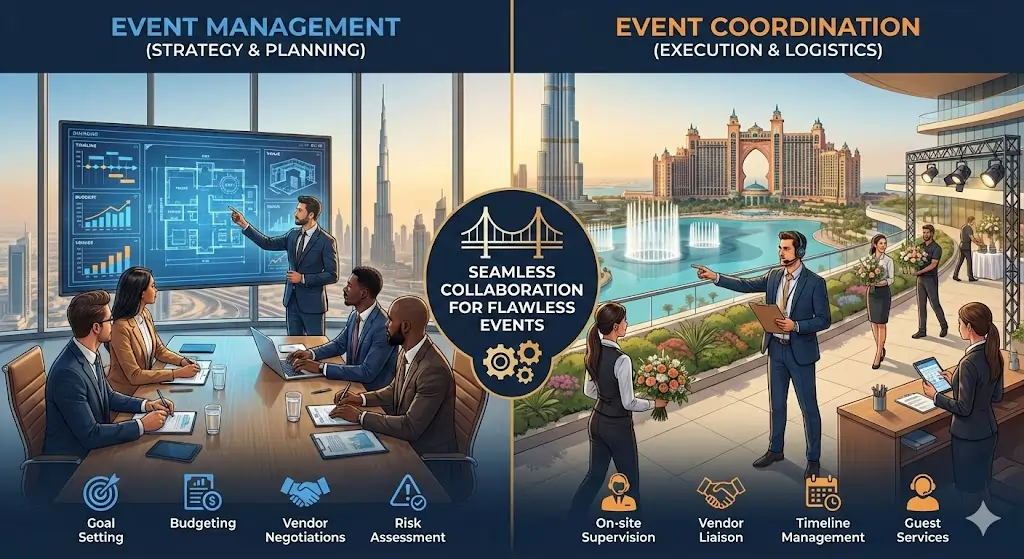
If you’re planning a major event in Dubai, you’ve likely come across the terms event coordination and event management. These roles sound similar and are often used interchangeably, but they have distinct functions. Event Coordination vs Event Management – what exactly is the difference, and who do you need for your event? In this post, we’ll break down the key differences between an event coordinator and an event manager from a Dubai perspective. By understanding each role and how they complement each other (especially in Dubai’s fast-paced, luxury event scene), you can ensure you hire the right expertise for a flawless event.
What Does an Event Coordinator Do?
An Event Coordinator is the professional responsible for managing the logistical details of an event and ensuring everything runs smoothly. In a Dubai context, coordinators often work closely with dubai event organizer teams to align with high service standards. Their duties often include creating detailed timelines and checklists, handling vendor communications, coordinating deliveries and setups, and troubleshooting issues in real-time. On the event day, the coordinator is typically the person running around with a headset or clipboard, double-checking that the stage is set, the catering is on schedule, and the AV equipment is functioning properly.
In a Dubai context, an event coordinator’s role might involve liaising with local vendors and venue staff to align with Dubai’s high service standards. For example, the coordinator may secure special permits from authorities for an outdoor event at a beach in JBR, ensure the décor team has access to Burj Al Arab’s ballroom for early setup, or arrange guest transportation through Downtown Dubai’s busy traffic. They are hands-on executors, focusing on event logistics and on-site coordination. Importantly, event coordinators often work under the guidance of an event manager or as part of a larger planning team, concentrating on the finer details so that nothing is overlooked. Their goal is to guarantee a seamless event execution according to the plan.
What Does an Event Manager Do?
An Event Manager (sometimes also referred to as an event planner) is the professional who oversees the entire event project from start to finish. You can think of the event manager as the architect and director of the event. Their responsibilities begin at the conceptual stage and continue through post-event wrap-up. Key duties of an event manager include consulting with the client to understand the event’s objectives, developing the overall theme or concept, planning the budget, selecting and booking the venue, and negotiating major vendor contracts. The event manager creates the master plan and production schedule that the whole team will follow. They also assemble and lead the team – which often includes event coordinators, designers, technical crews, and other specialists – ensuring everyone knows their role and timeline.
In Dubai’s corporate event scene, an event manager’s role might entail high-level coordination with venue management and even government bodies for permits, especially for large-scale productions. For example, the event manager might work with the Dubai World Trade Centre to secure multiple conference halls and layout plans, line up keynote speakers and sponsors for a summit, and ensure all safety regulations are met for a high-profile expo. During the event, the manager will monitor proceedings from a bird’s-eye view, ready to make executive decisions or solve major issues (while the coordinators handle on-the-spot logistics). Essentially, the event manager is responsible for strategic planning and smooth execution, making sure the event achieves its goals and delivers a memorable experience. They are often the primary point of contact for the client, providing updates and reassurance that all aspects of the event – from creative design to logistical delivery – are on track.
Here, professional event planners in Dubai are expected to deliver world-class creativity and project leadership because Dubai events operate at global standards.
Key Differences Between Event Coordinators and Event Managers
While both roles aim to make sure an event succeeds, there are clear differences in their scope and focus:
- Scope of Responsibilities: Event managers handle the comprehensive scope of the event – from initial concept, content and design, to high-level decisions and post-event evaluation. Event coordinators, on the other hand, focus on specific operational details, ensuring each element of the manager’s plan is executed correctly.
- Planning vs. Execution: The event manager is heavily involved from day one, often months before the event, crafting the overall plan and strategy. The event coordinator’s main involvement intensifies as the event date approaches and especially on the event day, orchestrating the execution according to the plan. (In practice, coordinators may also assist with planning, but execution is where they shine.)
- Client Interaction: The event manager is usually the primary client liaison – they discuss goals, present proposals, and provide updates, managing high-level expectations. Coordinators typically interact more with vendors and on-ground staff than with the client directly. For example, a client in Dubai will likely brainstorm ideas and review plans with the event manager, whereas the coordinator will be behind the scenes making those plans happen.
- Decision-Making: Event managers make the big calls – selecting the venue, approving the theme, allocating budget, and resolving major problems. Event coordinators make on-the-spot decisions within their realm – like adjusting the schedule when a speaker is running late, or finding a quick replacement if a vendor fails to deliver – often consulting the event manager for support if needed.
- Hierarchy and Teamwork: In larger events, the event manager often supervises one or more event coordinators. The coordinator works as part of the event management team. In essence, the coordinator is an extension of the event manager’s strategy, ensuring no detail is missed. In smaller events, a single person might perform both roles, but they’ll still switch between the “manager hat” (big-picture planning) and the “coordinator hat” (detail-focused execution) as needed to cover all tasks.
Why Both Roles Are Essential for Dubai Events in 2026
In Dubai’s thriving 2026 event landscape, having both strong management and coordination is more important than ever. Events are becoming more high-tech, larger in scale, and diverse in format – which means the tasks of managers and coordinators are evolving and expanding.
For instance, consider the rise of hybrid corporate events and advanced tech tools (AI-driven scheduling, smart registration systems, event apps, etc.). An event manager might decide to integrate a virtual attendance component or use an AI-powered guest registration system as part of the event strategy. It then falls to the event coordinator to implement these decisions on the ground – setting up the live streaming infrastructure, managing the platform for remote attendees, and handling the software for real-time Q&A between in-person and online participants. Without an event manager to plan these innovations and a coordinator to execute them, it would be difficult to deliver a seamless experience to all attendees, especially for corporate event coordination in Dubai, where expectations for precision and luxury are exceptionally high.
Similarly, trends toward sustainability and culturally conscious planning require attention from both roles. A Dubai event manager may incorporate sustainable practices into the plan (choosing a green-certified venue, planning eco-friendly giveaways, scheduling the programme to minimise waste). This aligns with the growing demand for sustainable event planning across the UAE.The event coordinator then ensures those plans come to life – for example, coordinating with vendors to use recyclable materials, arranging donation of leftover food, or setting up segregated recycling bins at the venue. In terms of cultural and timing considerations, the event manager will plan around local calendars (avoiding major clashes with Ramadan or national holidays), and the coordinator will handle fine details like adjusting catering and schedules for an iftar during Ramadan or setting up a prayer area on site.
Dubai’s events often operate at a grand scale – think of international expos, large incentive conferences, or luxury brand launches on Palm Jumeirah. In such cases, the event management team (led by the event manager) sets the vision and secures high-level requirements, while a crew of event coordinators takes charge of various sections. For example, one coordinator might handle venue logistics and staging at the Dubai World Trade Centre, another oversees VIP guest hospitality and transportation from Dubai Marina, and another manages the entertainment and audio-visual crew. This collaborative approach ensures every aspect of the event is given proper attention by someone.
In short, for a complex corporate event in Dubai, you need the strategic oversight that an event manager provides, as well as the precision and hands-on control that event coordinators deliver. Skimping on either can jeopardize the outcome. That’s why reputable agencies like Xotic Xperiences assign dedicated project managers and on-site coordinators to every project – covering all bases from big-picture planning to minute-by-minute execution.
Understanding these differences will help you assemble the right team for your next event. In a city like Dubai where no detail is too small and no idea too big, having the correct mix of leadership and coordination is the formula for success. Whether you’re a company planning a product launch or a gala dinner, it pays to have both roles covered. If you’re unsure what level of help you need, it’s wise to consult a professional agency. Xotic Xperiences offers end-to-end event solutions – our clients get the benefit of both visionary event managers and detail-oriented coordinators working together. With such a comprehensive event planning in Dubai approach, you won’t have to worry about any aspect falling through the cracks.
Ready for flawless corporate event coordination in Dubai? Contact Xotic Xperiences today for a free consultation.
Frequently Asked Questions (FAQs)
What is the main difference between event coordinator and event manager?
An event manager handles overall planning, strategy, vendors, and budget, while an event coordinator manages detailed logistics, scheduling, and on-site execution — the manager creates the plan, the coordinator delivers it.
Can one person do both event management and event coordination?
Yes for small events, but large Dubai events require both — one manager for strategy and coordinators for on-ground execution so no task is missed.
Do I need an event manager for a small corporate event in Dubai?
If the event is simple, a coordinator may be enough; but for polished, high-quality corporate events, a manager ensures creativity, planning, and nothing overlooked.
How do event managers and event coordinators work together during an event?
Managers guide overall flow and decisions, while coordinators handle specific areas like registration, catering, backstage, or tech, working together to fix issues quickly.
Do event management companies in Dubai provide both coordinators and managers?
Yes, reputable companies like Xotic Xperiences provide an event manager plus a team of coordinators so planning and execution are both fully covered.