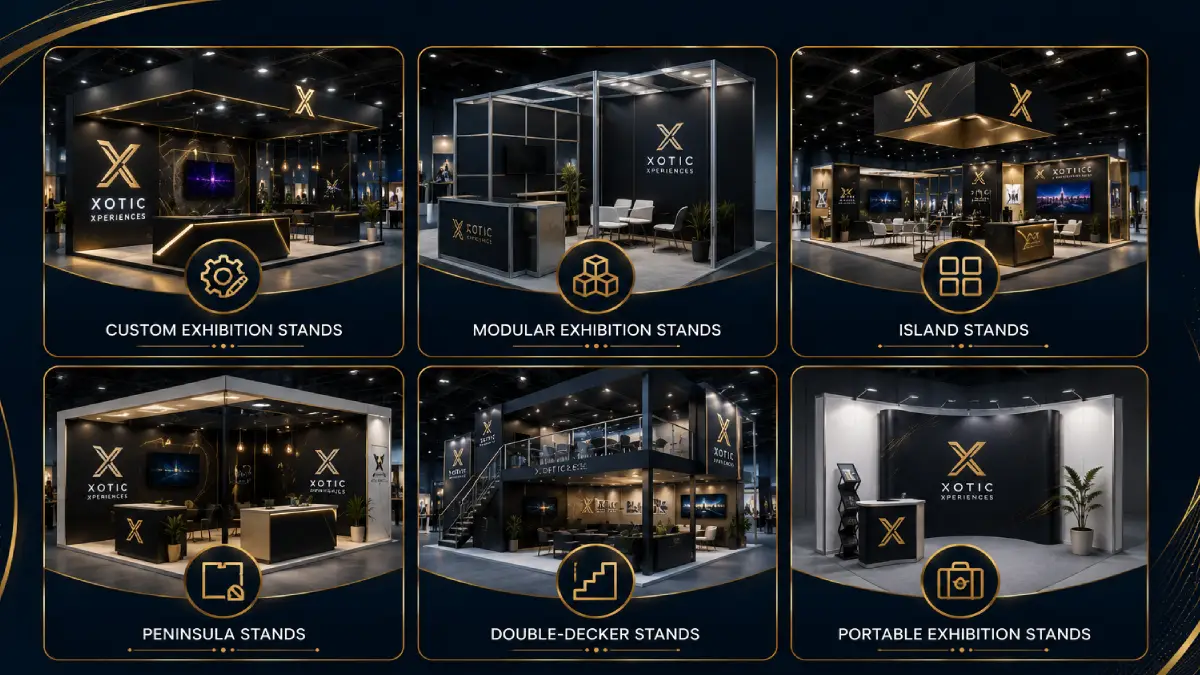
The types of exhibition stands used in Dubai are custom, modular (including shell scheme), island, peninsula, double-decker, and portable stands. Custom stands are bespoke builds designed around one brand, modular and shell scheme stands use reusable components with the organizer providing basic walling at venues like Dubai World Trade Centre, island stands offer open access from all four sides for maximum visibility, peninsula stands are open on three sides, double-decker stands add a second level to maximize space at high-value shows like GITEX, and portable stands offer a lightweight, low-cost option for smaller events. The right type depends on your available space, budget, and branding goals for the specific show.
Overview of Types of Exhibition Stands
Walk the halls of Dubai World Trade Centre during GITEX and you’ll see the same product category – say, cybersecurity software – presented six different ways within fifty metres. One brand has a two-storey structure with a private meeting room upstairs. Next door, a startup has a single pop-up banner and a table. Both paid for a stand. Neither paid for the same thing.
An exhibition stand isn’t one product – it’s a category of very different physical structures, and picking the wrong one wastes budget whether you overspend on space you don’t need or underspend on visibility you can’t afford to skip. The right type depends on your available space, your budget, your branding ambitions, what you’re trying to achieve at the show, and what the specific event and venue actually allow. Get any one of those wrong and even a beautifully designed stand underperforms.
This guide covers the six main types of exhibition stands – custom, modular, island, peninsula, double-decker, and portable – what each one actually is, when it makes sense, and how to choose between them without guessing.
What Should You Know About Exhibition Stand
An exhibition stand is the physical space and structure a business uses to present itself, its products, and its brand at a trade show, exhibition, or conference. It’s built or rented for the duration of the event and typically includes walling, signage, product display areas, and – depending on the type – seating, storage, and meeting space.
Think of it as a temporary storefront. For the length of the show, it’s the only physical representation of your company most visitors will ever see. That’s why the “type” of stand matters as much as the design sitting on top of it – the type determines how much space you get, how visible you are from the aisle, and how much you can customize before you’ve even picked a colour scheme.
Most businesses don’t build one of these alone. An experienced exhibition stand builder handles the structural and logistical side – permits, materials, on-site build, so you can focus on the brand experience rather than the engineering behind it.
What Are the Different Types of Exhibition Stands?
The different types of exhibition stands are custom, modular, island, peninsula, double-decker, and portable stands – each defined by how much of the stand is open to visitor traffic, how it’s built, and how much customization it allows.
Here’s the one-line version of each:
- Custom exhibition stands are fully bespoke builds designed around your brand from the ground up.
- Modular exhibition stands use reusable components you can reconfigure for different show sizes.
- Island stands are open on all four sides, usually standing alone in the middle of the floor.
- Peninsula stands are open on three sides, backing onto a neighbouring stand.
- Double-decker stands add a second level, doubling usable floor space within the same footprint.
- Portable exhibition stands are lightweight, quick to set up, and built for exhibitors who move between shows often.
6 Types of Exhibition Stands
Here’s a closer look at each of the six main types of exhibition stands, what they involve, and who they actually suit.
1. Custom Exhibition Stands
A custom exhibition stand is built from scratch for one specific brand, one specific space, and – usually – one specific show. Nothing about it is off the shelf. The layout, materials, lighting, and structure are all designed around what you’re trying to say and sell, which is the entire appeal and also the entire cost driver.
Bespoke design means your stand doesn’t look like anyone else’s on the floor. That matters more than it sounds – at a show with 300 exhibitors, visual sameness is the enemy. A custom build lets you control every branding surface: wall shape, ceiling structure, flooring, even the sound in the space. Layouts can flex around whatever the space allows, rather than forcing your brand into a fixed module. Interactive features – product walls, AR touchpoints, live demo zones – get built into the structure itself instead of bolted on afterward.
Choose custom when the show is a flagship one for your business, when your brand needs to visually dominate its category, or when your product genuinely needs a layout no standard system can accommodate. It’s the wrong call for a smaller regional show where the budget doesn’t justify a one-off build – that’s what modular and portable options exist for.
This is also where it pays to shop around. Not every contractor builds to the same standard, and the better exhibition stand builders in UAE will tell you upfront whether a custom build actually suits your budget and timeline, rather than selling you one regardless.
The trade-off is straightforward: custom stands cost more, take longer to design and build, and usually can’t be reused as-is for a different space or show. If you’re weighing this against other formats, our creative exhibition stand design ideas page has more on what a bespoke build can actually look like.
2. Modular Exhibition Stands
A modular exhibition stand is built from a system of reusable components – panels, frames, lighting rigs, counters – that get assembled into different configurations depending on the space you’re given. Instead of designing a new structure every time, you’re reconfiguring a kit.
This is also where “shell scheme” comes in, and it’s worth being precise about the term because it gets used loosely. A shell scheme is a specific type of modular setup: the event organizer provides a basic pre-built shell – usually white wall panels, a fascia board with your company name, and sometimes carpet and basic lighting – as part of your stand package. It’s standard at Dubai World Trade Centre and most UAE venues for exhibitors who book “shell scheme” space rather than “space only.” You then dress that shell with your own branding, furniture, and displays. A modular stand you own and rebrand for each show is a step up from shell scheme – same reusable-components logic, but you control the components instead of the organizer.
The appeal is cost-effectiveness paired with real flexibility. The same modular kit can shrink to fit a 3x3m shell scheme booth or expand to a larger space-only plot, and because the components are reusable, the cost of your second and third show drops sharply compared with building custom each time. Reconfiguration is genuinely fast – most modular systems go up and down in hours, not days.
Modular suits exhibitors doing multiple shows a year, brands still testing which events are worth a bigger investment, and anyone who wants a consistent look across venues without a bespoke price tag each time.
3. Island Stands
An island stand sits in open floor space with visitor access from all four sides – nothing backs onto a wall or a neighbouring exhibitor. It’s the most exposed stand format on the floor, and that’s exactly why brands pay a premium for the position.
Four-sided access means visitors can approach from any direction, which removes the “front only” bottleneck you get with smaller formats. Visibility is about as high as it gets at a trade show – an island stand is visible from every aisle around it, not just the one it faces. That makes it the format of choice when branding needs to work as a landmark: tall structures, hanging signage, and large-format graphics all read well because there’s no adjacent wall blocking sightlines.
Island stands need a genuinely open plot, which usually means a larger space-only booking and a bigger budget to match – you’re paying for both the real estate and the fact that every side of the structure needs to look finished, because every side is visible. That’s also the practical limitation: a small island stand can look sparse rather than commanding, so the format works best at a certain minimum size.
4. Peninsula Stands
A peninsula stand is open on three sides and backs onto one neighbouring stand on the fourth. It’s effectively the middle ground between an island stand’s total exposure and a smaller stand’s single open face.
The difference from an island stand comes down to that one closed side. You lose a bit of visibility and lose the ability to brand that back wall from the outside – but you gain a surface. That back wall becomes useful real estate: a large branded backdrop, a product wall, or a private area shielded from the show floor, none of which an island stand can offer without breaking up its open feel.
Visitor flow on a peninsula stand tends to move around three sides rather than through the middle, so layout planning matters more here than on an island stand – you’re guiding traffic along an L-shaped or U-shaped path rather than letting people cut straight across.
Peninsula stands work well for brands that want strong visibility without the full island footprint and budget, and for exhibitors who specifically want a solid back wall for branding, storage, or a semi-private meeting space.
5. Double-Decker Stands
A double-decker exhibition stand adds a second level to the structure, effectively doubling your usable floor space within the same footprint on the show floor. Ground level typically handles the public-facing brand experience – product displays, demos, reception – while the upper level is used for private meetings, hospitality, or additional storage.
The value proposition is straightforward: exhibition floor space is expensive per square metre, and a double-decker stand lets you get two levels of function out of one plot’s rental cost. Upper-level meeting areas in particular solve a real problem – ground-floor meetings at a busy stand get interrupted constantly, while an upstairs space gives sales teams somewhere quiet to actually close a conversation. Branding opportunities also expand vertically; a two-level structure is visible from further across the hall than a single-storey stand of the same footprint.
The catch is structural. A double-decker build is a genuine construction project, not a display system, and UAE venues including Dubai World Trade Centre require structural drawings and engineering sign-off before approving one – the same goes for most major international venues. That approval process needs to start well before the show, not weeks out, and it adds real cost on top of the build itself. Double-decker stands also need floor-load and height clearance the venue has to confirm in advance, so this format only makes sense at shows and venues built to support it.
6. Portable Exhibition Stands
A portable exhibition stand is a lightweight, pre-built display system – pop-up banners, pull-up displays, modular fabric frames – designed to pack down small, travel easily, and go up without tools or a build crew.
Easy transportation is the entire point. Most portable systems fit into a case one person can carry, which matters if you’re exhibiting at several regional shows across a season and can’t justify freight costs for a heavier build each time. Setup usually takes minutes, and the same units get reused show after show with a fresh set of graphics.
Best uses are smaller shows, secondary activations alongside a bigger stand elsewhere in the hall, and any situation where budget or logistics rule out a larger build. The advantage is speed, cost, and reusability. The limitation is visual impact – portable stands can’t compete with a custom or island build on scale or branding surface, and they read as a lower-tier presence at a show where most competitors have invested in bigger builds. Right event and right budget, though, and portable is the sensible choice rather than a compromise.
Exhibition Stand Types Comparison
| Stand Type | Visibility | Customization | Space Requirement | Best For |
| Custom | High | Very High | Varies | Strong branding |
| Modular | Medium–High | High | Flexible | Reusable campaigns |
| Island | Very High | High | Large/open space | Maximum visibility |
| Peninsula | High | High | Medium–Large | Three-side access |
| Double-Decker | Very High | High | Large | Extra usable space |
| Portable | Medium | Moderate | Small–Medium | Mobility and simplicity |
How to Choose the Right Exhibition Stand Type
Start with the exhibition space itself – what size plot are you actually being offered, and is it shell scheme or space only? That answer alone rules out several formats before you get to preference. A 12sqm shell scheme booth was never going to be an island stand.
Stand size and budget move together. Bigger formats – island, double-decker – cost more in both floor space and build, so decide what you’re willing to spend before you fall in love with a layout you can’t afford. Branding requirements matter next: if the goal is category dominance and top-of-mind recall, that points toward custom or island. If the goal is a consistent, cost-controlled presence across several shows a year, modular wins.
Think about the number of visitors you’re expecting and whether your layout can actually handle that traffic without bottlenecking at the entrance. Product display requirements shape the floor plan directly – a stand full of physical inventory needs different flow than a stand built around a single hero demo. If you’re running client meetings on-site, meeting areas need to be planned in from the start, not squeezed in later; this is where double-decker or peninsula stands with a closed wall have a real advantage over an open island format.
Storage requirements get overlooked constantly – where do the extra brochures, spare parts, and staff bags actually go once the doors open? Reusability matters if you’re exhibiting more than once a year: a modular or portable system that survives multiple shows costs less over time than repeated custom builds. Check event regulations early too – height limits, structural approval requirements, fire safety rules, and venue-specific build restrictions vary by show and can eliminate options you’d otherwise choose. And factor in installation and dismantling requirements: a custom or double-decker stand needs several build days and a licensed contractor, while a portable stand goes up in an afternoon.
How to Design an Effective Exhibition Display Stand
Create Clear Branding
Your logo, colours, and core message should be readable from the aisle, not just up close. If someone can’t identify what you do from fifteen feet away, the stand isn’t working before a single visitor walks in.
Design for Visitor Flow
Plan the path people take through the stand before you finalize furniture placement. A stand that funnels visitors into a dead end, or forces them to squeeze past a reception desk, loses people who’d otherwise have stayed.
Make Products Easy to See
Product displays need height, lighting, and open sightlines – not clutter. If your product is the reason people stop, don’t bury it behind a counter or a crowd of banners competing for the same attention.
Add Interactive Elements
Something people can touch, try, or engage with holds attention far longer than signage alone. A working demo, a screen with a real interaction rather than a looping video, or a hands-on product sample all do more than another wall of text.
Include Comfortable Meeting Areas
Even a small stand benefits from somewhere to sit down with a serious lead. A rushed conversation standing up in a busy aisle rarely converts the way a five-minute seated chat does.
Use Effective Lighting
Lighting shapes how a stand reads from a distance more than most exhibitors expect. Flat, even lighting makes a stand disappear into the row; focused lighting on key products or graphics pulls the eye exactly where you want it.
Provide Storage
Every stand needs somewhere for bags, spare stock, and staff belongings that isn’t visible to visitors. Skip this and you’ll end up with boxes under the counter within the first hour of the show.
Add Clear Calls to Action
Decide what you actually want a visitor to do – book a meeting, scan a code, leave a card – and make that action obvious. A stand that looks great but doesn’t direct visitors toward a next step generates attention without generating leads.
Common Mistakes When Choosing an Exhibition Stand Type
Choosing a stand based only on price. The cheapest option per square metre isn’t cheap if it can’t hold your product line or handle expected footfall – you end up paying for the show twice, once for the stand and again in lost leads.
Ignoring visitor flow. A stand type that looks right on paper can create bottlenecks in practice. Peninsula and island layouts especially need a real walk-through plan, not just a floor plan on a screen.
Overcrowding the design. More graphics, more products, more signage doesn’t add up to more impact – it usually reads as noise and visitors disengage faster.
Poor branding visibility. A gorgeous stand that doesn’t communicate who you are from the aisle has failed at its one job. Branding needs to work from a distance before it works up close.
Not considering storage. This gets left out of early planning constantly, and it shows on day one when there’s nowhere to put anything.
Forgetting meeting space. Teams that plan to close deals on-site but skip a proper meeting area end up having sensitive conversations standing in the open, which costs more leads than the square metres saved.
Ignoring venue regulations. Height restrictions, structural approvals, and fire codes vary by venue and show. Find out what your specific event allows before you commit to a stand type, especially for double-decker or large custom builds.
Leaving design and production too late. Custom and double-decker stands need real lead time for design, structural approval, and build. Starting six weeks out for a stand that needs three months of production is how good ideas get value-engineered down to something generic.
Conclusion
The six main types of exhibition stands – custom, modular, island, peninsula, double-decker, and portable – each solve a different combination of space, budget, and objective. None of them is universally “better.” A custom island build makes sense for a flagship product launch at GITEX; a portable pop-up makes just as much sense for a smaller regional show three months later.
The right choice comes down to matching the stand type to your actual space, your actual budget, and what you need the visitor experience to accomplish – not to whichever format looks most impressive in a portfolio. Get that match right and even a modest stand outperforms a bigger one built on the wrong assumptions.
Xotic Xperiences designs and builds all six stand types across Dubai and the wider UAE, from shell scheme fit-outs to full custom and double-decker builds. If you’re weighing which format fits your next show, talk to our Exhibition Stand Builder & Design Company in Dubai and we’ll help you match the stand to the space.
Frequently Asked Questions
What are the different types of exhibition stands?
The main types are custom, modular, island, peninsula, double-decker, and portable exhibition stands. They differ mainly by how many sides are open to visitors, how much customization they allow, and how they’re built.
What are the most common types of exhibition stalls?
Modular and custom stalls are the most common at large trade shows, since they cover the widest range of budgets and space sizes. Portable stands are the most common choice for smaller shows and secondary activations.
Which type of exhibition stand is best for a small business?
A modular or portable stand usually suits a small business best, since both offer strong flexibility and reusability without the cost of a custom build. Shell scheme space paired with a modular fit-out is often the most practical starting point.
What are common types of booths?
Common booth types include inline booths (open on one side), corner booths (open on two sides), peninsula booths (open on three sides), and island booths (open on all four sides) – the same open-side logic that defines exhibition stand types generally.
What are the different types of booths?
Beyond the open-side classification, booths also vary by build type – custom, modular, portable, or double-decker – which determines how much branding and structure they can support regardless of how many sides face the aisle.